


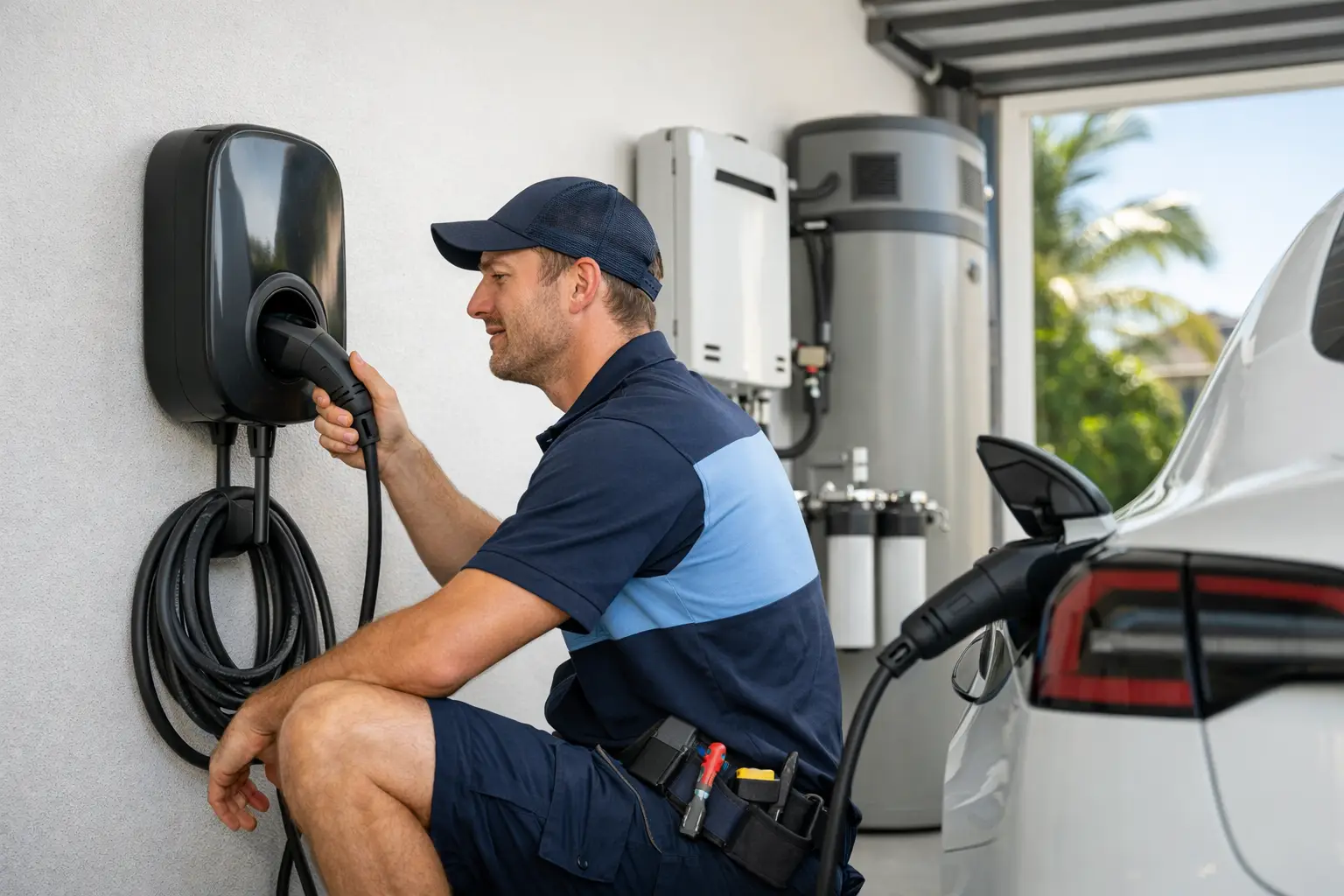
If you have just bought an EV, the first real question usually hits when you get home and look at the powerpoint in the garage. Will that do the job, or do you need a proper charger installed? A good guide to home charging setup starts there, because the right answer depends on how you drive, how quickly you need to recharge, and what your home can safely support.
For most households, home charging is the easiest part of EV ownership once it is set up properly. You plug in overnight, wake up with usable range, and stop planning your week around public chargers. The catch is that not every home is ready for the same setup, and the cheapest option upfront is not always the most practical one long term.
What a home charging setup actually involves
A home charging setup is more than the charger on the wall. It includes the charger itself, the existing switchboard, the available electrical capacity in the home, cable run distance, where the vehicle parks, and whether load management or switchboard upgrades are needed.
That matters because two homes on the same street can need completely different installations. One may have a modern switchboard and a garage beside the meter box, making installation straightforward. Another may have an older board, a longer cable run to a carport, and several large appliances already competing for power.
This is why a practical guide to home charging setup should focus on fit, not just product specs. The best charger is the one that works safely with your home and suits your routine without creating extra cost or hassle later.
Start with how you actually use your car
Before choosing a charger, think about your weekly driving rather than the biggest charging speed available. If you mainly do school runs, commuting, and local errands, your daily energy use may be low enough that moderate overnight charging covers everything comfortably. If you do longer drives for work, carry a higher weekly kilometre load, or have more than one EV at home, faster charging may make more sense.
Parking habits matter too. If your vehicle always goes in the garage for the night, a fixed wall charger is easy to live with. If you sometimes park on the driveway or under a carport, charger position and cable length become more important. Small layout details can make the difference between a setup you use every day and one that becomes annoying after a week.
Portable charging vs a dedicated wall charger
Most EVs come with a portable charging cable that can plug into a standard powerpoint. This can work as a short-term option, especially for low daily usage. It is usually the slowest method, and for some households it may be enough for topping up overnight.
The trade-off is speed and convenience. Standard powerpoint charging is slower, and it is not always ideal as a permanent solution if your daily driving is higher or your household power usage is already heavy. You also need to think carefully about circuit condition and safety. An older powerpoint or circuit is not something to guess about.
A dedicated wall charger is the better long-term option for most homeowners. It charges faster, is designed for regular EV use, and can include features like scheduling, energy monitoring, and load balancing. It also tends to be a cleaner, tidier setup with fewer compromises.
Single-phase or three-phase – what matters most
One of the most common questions in any guide to home charging setup is whether to install a single-phase or three-phase charger. The answer depends on your home supply and your vehicle’s charging capability.
Many homes have single-phase power, and for plenty of drivers that is completely suitable. If your EV sits at home overnight, a single-phase charger often provides more than enough time to recover daily driving needs.
Three-phase can deliver faster charging where the home supply supports it and the vehicle can accept it. That can be worthwhile if you drive long distances, want shorter charging windows, or are planning ahead for future vehicle upgrades. But faster is not automatically better. If your car is parked for 10 to 12 hours most nights, you may not benefit much from paying extra for capacity you rarely use.
Check your switchboard before choosing the charger
A charger should be selected with the home, not in isolation. Your switchboard condition, available capacity, and overall household load all need to be assessed properly. Large appliances like air conditioning, ovens, pool equipment and hot water systems can affect what is practical.
In some homes, installing an EV charger is straightforward. In others, a switchboard upgrade or protective devices may be required to meet safety standards. That is not bad news – it is simply part of doing the job properly. The goal is a setup that works safely every day, not one that only looks good on paper.
This is also where load management can be valuable. Rather than overloading the home when multiple appliances are running, a smart charger can adjust output to stay within available limits. For busy households, that can avoid bigger upgrade costs while still delivering a very usable charging setup.
Where the charger should go
The best charger location is not always the nearest wall. It needs to be practical for daily parking, protected where possible, and positioned so the cable reaches the car comfortably without creating a trip hazard or cluttered access point.
Garage installations are often the simplest, but carports and external walls can work well too when the equipment is rated appropriately. The cable route from switchboard to charger also affects installation complexity and cost. A charger mounted close to where the car actually parks can save frustration, even if it is not the absolute shortest route for the installer.
If you are building, renovating, or planning a garage update, it is worth thinking ahead. Even if you do not need the fastest charger now, allowing space and electrical planning for future EV needs can save money down the track.
Smart features worth paying for
Not every extra feature is worth it, but a few can make a genuine difference. Scheduled charging is useful if you want to charge overnight or make the most of off-peak tariffs. Energy monitoring helps you understand running costs and usage patterns. Load balancing can be especially valuable in homes with higher electricity demand.
App control is popular, though not essential for everyone. Some households love the visibility and control. Others just want to plug in and forget about it. The right choice comes down to how hands-on you want to be.
Solar compatibility is another area to consider. If you already have solar, or plan to add it, some chargers are better suited to using excess generation. That can improve charging economics, although results depend on when the car is home and how your system performs through the day.
What affects installation cost
Home EV charger pricing varies because installation conditions vary. The charger unit is only one part of the total cost. Labour, cable length, switchboard work, protective equipment, trenching if required, and charger location all play a role.
This is why fixed, transparent quoting matters. A low advertised charger price does not help much if the real installation cost only becomes clear halfway through the job. Homeowners are better served by a proper assessment and a clear quote upfront, so there are no surprises when it is time to install.
There is also a balance between cost now and cost later. Choosing the cheapest setup may be fine if it genuinely suits your usage. But if you are likely to add a second EV, install solar, or need faster charging in the near future, it can make sense to plan for that now rather than paying twice.
Safety is not the place to cut corners
An EV charger is a high-use electrical appliance. It needs to be installed correctly by a licensed electrician, with proper circuit protection and compliance with current standards. That protects your vehicle, your home, and the people living in it.
It is tempting to treat charging like any other household appliance, especially if a standard powerpoint seems to work. But regular EV charging places sustained demand on electrical circuits. A proper assessment helps identify whether your current setup is suitable or whether a dedicated circuit is the safer option.
For homeowners who already rely on one trusted provider for electrical, gas and other home services, using a qualified team that can assess the broader household setup makes life easier. It means fewer moving parts, clearer communication, and less chance of something being missed.
Getting the right setup the first time
The simplest way to approach home charging is to think in three layers. First, what does your driving routine require? Second, what can your home support safely? Third, what will still suit you in a few years?
That usually leads to a better decision than starting with the charger brand or top charging speed. A well-matched setup feels easy from day one. You come home, plug in, and get on with your evening without thinking twice about it.
If you want your EV to be convenient, your home charging setup needs to be convenient too. The right system is not the flashiest one on the market. It is the one that suits your home, your budget, and the way you actually live. A clear quote, licensed installation, and practical advice will get you there faster than chasing specs alone.
The best charging setup is the one you never have to wrestle with when you get home tired at the end of the day.