


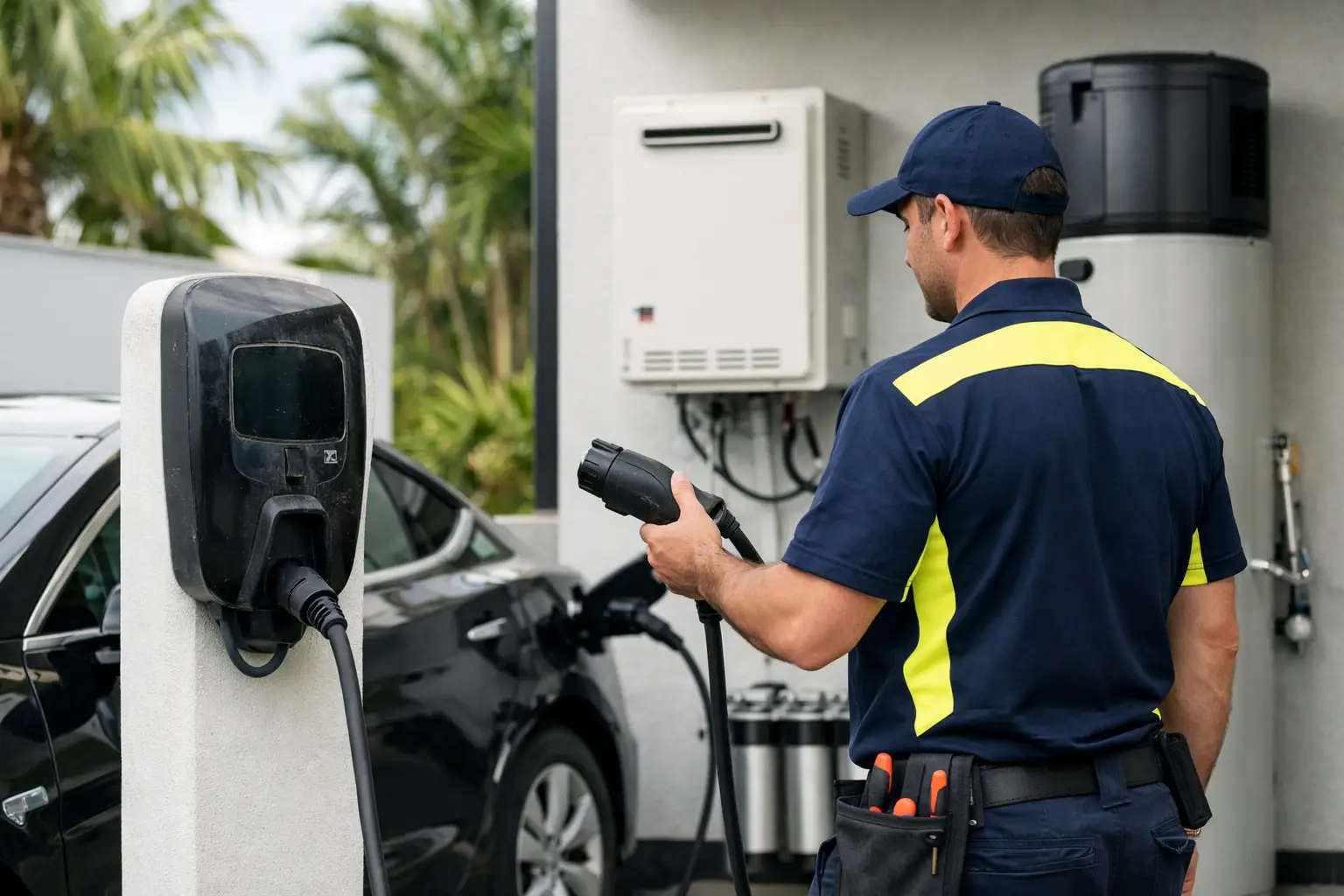
An EV charger can work quietly for years, then start showing its limits when you buy a larger electric vehicle, add solar, install air conditioning, or notice the household power working harder at night. So, do EV chargers need upgrades? Sometimes, yes – but an upgrade is not automatically required just because your charger is getting older.
The right answer depends on your car, charger, switchboard, wiring and the way your household uses power. A licensed electrician can assess the complete setup and explain what is needed, without pushing you into work that does not suit your home.
When do EV chargers need upgrades?
Most home chargers do not have a fixed expiry date. If the unit is charging reliably, has been installed correctly and still meets your needs, there may be no reason to replace it. The charger itself is only one part of the system, though. Your home’s electrical capacity matters just as much.
An upgrade becomes worth considering when your charging needs change, your charger develops faults, or the electrical system cannot comfortably support the load. Home charging typically happens over several hours, often overnight, which means the circuit and switchboard need to handle a sustained demand safely.
For some households, the solution may be a newer charger. For others, it may be a dedicated circuit, switchboard work, load management or simply a professional check that confirms everything is in good order.
Signs your current setup may be struggling
The clearest sign is a charger that will not run consistently. Repeated tripping at the switchboard, charging sessions that stop without explanation, warning lights or error messages are all reasons to arrange an inspection. Do not keep resetting a circuit breaker and hoping the problem disappears. It is there to protect your home.
Slow charging can also point to an issue, although it is not always a fault. Your vehicle may be set to a lower charge rate, the charger may have been configured conservatively, or your energy supply may be limiting the available power. A qualified installer can work through these possibilities and check whether the charger is delivering the rate it should.
Heat is another warning sign. A warm charger can be normal during use, but excessive heat, a hot plug, discoloured fittings, a burning smell or buzzing from electrical equipment needs prompt attention. Switch off charging if it is safe to do so and seek professional advice.
Older homes can need a closer look, particularly where switchboards, cabling or protective devices have not been updated for many years. This does not mean every older Gold Coast or Tweed home needs major electrical work. It does mean assumptions are risky. The condition and capacity of the existing installation should be checked before increasing the charging load.
A new EV can change the calculation
Moving from a plug-in hybrid to a fully electric family vehicle is a common reason to review a home charger. Your old setup may still work, but a vehicle with a larger battery can make charging times less convenient. If you arrive home with a low battery and need the car ready early the next morning, a faster and properly sized charging solution can make daily life easier.
The same applies when a household adds a second EV. Two cars charging after work, while dinner is cooking and the air conditioner is running, creates a very different demand to one vehicle charging a few nights a week.
Your switchboard is part of the charger system
A wall-mounted EV charger may look like a standalone appliance, but it relies on the wiring and protection behind it. The switchboard needs enough capacity for the home and must be fitted with suitable protective devices. Cabling needs to be correctly sized for the charger, route and load.
This is why a proper assessment matters. An electrician will consider the size of your electrical supply, the existing major appliances, cable run, condition of the switchboard and where the charger will be located. A long run from the switchboard to a garage or carport, for example, may need different cable sizing than a charger installed close by.
Some homes can benefit from a switchboard upgrade because the existing board is full, outdated or unable to accommodate the required protection. Other homes may only need a dedicated circuit for the charger. The goal is not to replace more than necessary. It is to make sure the installation is safe, compliant and suited to the way you use your home.
Load management can avoid unnecessary limits
Many homeowners assume they need the largest possible electrical upgrade to charge an EV quickly. That is not always the case. Smart chargers and load management systems can monitor the household’s electricity demand and adjust the charging rate when other high-demand appliances are running.
For example, charging can reduce temporarily while the oven, hot water system and air conditioning are all operating, then increase again once household demand drops. This can help avoid overloading the supply while still ensuring the car receives a useful charge overnight.
It is a practical option for busy homes, especially where upgrading the incoming supply would be costly or unnecessary. The trade-off is that charging speed may vary at peak household times. For many families, that is a fair exchange for safe charging and lower upgrade costs.
Older chargers may miss useful features
An older charger can be electrically sound but less convenient than newer models. Depending on the unit, an upgrade may give you scheduling, app controls, energy monitoring, solar-aware charging or automatic load management.
Scheduling is useful if you want to charge during selected hours rather than as soon as the car is plugged in. Energy monitoring can show how much electricity the vehicle is using, which helps households understand running costs. Solar-aware charging may suit homes with solar panels, particularly where the car is regularly at home during daylight hours.
These features are not essential for every driver. If your current charger is dependable and your routine is simple, replacing it solely for extra functions may not be worthwhile. But if you are trying to make better use of solar generation, manage two vehicles or keep closer track of energy use, a newer charger can be a sensible improvement.
Is a standard power point enough?
A portable charging lead plugged into a standard power point can be suitable in limited circumstances, provided the outlet and circuit have been assessed as appropriate. However, it is generally slower than a dedicated wall charger and may not be the best long-term answer for regular, high-demand charging.
Using extension leads, double adaptors or damaged power points for EV charging is not a safe workaround. An EV draws power for extended periods, and household electrical equipment needs to be selected and installed for that job. If charging from a standard outlet has become part of your daily routine, ask an electrician whether a dedicated solution would be safer and more convenient.
What happens during an EV charger assessment?
A good assessment should feel straightforward. The installer will discuss your vehicle, how far you usually drive, when you prefer to charge and whether another EV may be added later. They will inspect the proposed charger location, the switchboard and the practical cable route.
They should also consider other major electrical loads in the house, such as air conditioning, electric hot water, pool equipment and cooking appliances. From there, you can receive a clear recommendation: keep the existing setup, install a dedicated charger, add load management, upgrade the switchboard, or plan a broader electrical upgrade.
Ask for the quote to spell out what is included. Clear pricing makes it easier to compare options and prevents surprises once work begins.
Plan for the home you will have next year
The best EV charging setup is not necessarily the most powerful one. It is the one that safely fits your home, vehicle and routine, while leaving room for likely changes ahead. If you are renovating, adding solar, replacing a hot water system or expecting a second electric vehicle, mention it during the assessment.
For homeowners across the Gold Coast, Southern Brisbane and Tweed Heads, No Hassle Homes can help take the guesswork out of EV charger supply and installation. A quick, professional check now can give you confidence that every overnight charge is ready when your day starts.