


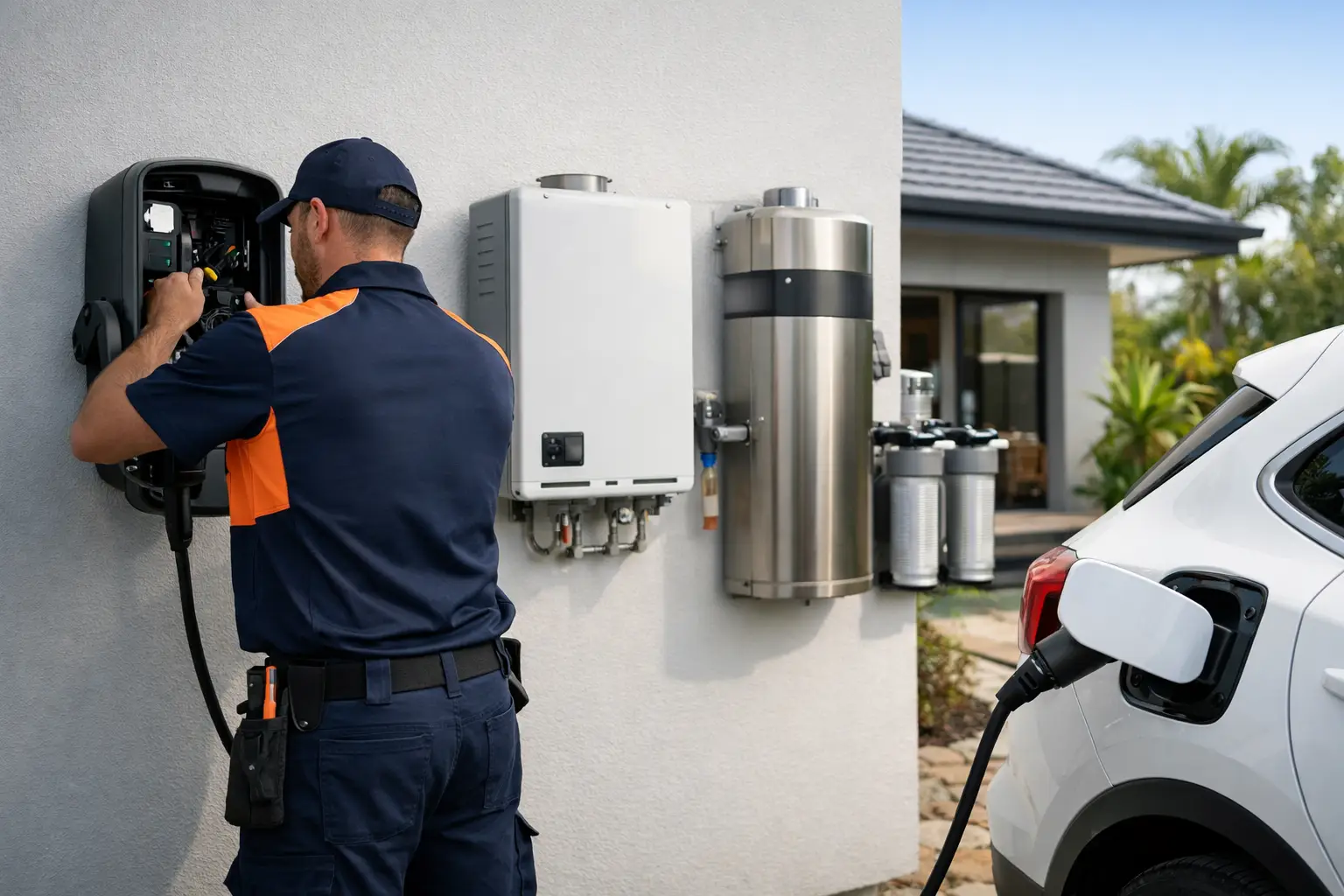
Your EV should be ready when you are, not waiting on a public charger while you are trying to get the kids to school or make it to work. To plan home EV charging properly, start with how you actually use your car, then match the charger, electrical supply and installation location to your home. A little planning upfront can prevent slow charging, awkward cable runs and unexpected electrical work later.
For most households, home charging is the simplest and most affordable way to keep an EV topped up. The right setup lets you plug in after dinner, charge overnight and leave with the range you need in the morning.
Start with your driving routine
Before comparing chargers, look at your usual week. How many kilometres do you drive on a normal weekday? Do you commute from the Gold Coast to Brisbane, do school drop-offs and errands locally, or only use the car a few times a week? The answer affects how much charging speed you genuinely need.
A vehicle that travels modest daily distances can often recover its usual usage overnight on a lower-powered setup. A busy household with one car doing long daily runs, or two EVs sharing one driveway, may benefit from a faster dedicated wall charger and a plan for who plugs in when.
Also consider the exceptions. Weekend trips, visiting family and school holidays can mean more kilometres, but they do not always justify buying the biggest charger available. Public fast charging can cover occasional long trips, while home charging handles the dependable day-to-day job. The best system is the one that suits most of your real life, not the most demanding day of the year.
Choose between a standard outlet and a wall charger
Some EVs can charge from a standard power outlet using the portable charging cable supplied with the vehicle. This may be useful as a temporary option or for very low daily driving, provided the outlet and circuit are suitable. However, it is usually slower and should not be treated as a shortcut around proper electrical assessment.
A dedicated wall-mounted EV charger is the better long-term choice for many homes. It can provide faster, controlled charging and is designed for regular use. Many units include scheduling, load management and app controls, which can help you charge during cheaper electricity periods or keep an eye on usage.
The charger power you choose depends on your vehicle, home supply and charging window. A higher-rated charger does not automatically mean faster charging if the car cannot accept that power, or if the home’s electrical system cannot support it without upgrades. An experienced installer can explain the practical options in plain language rather than selling you more capacity than you need.
Single-phase or three-phase power
Most homes have single-phase power, while some larger or newer properties have three-phase power. Three-phase supply can support higher charging rates, but it is not essential for every EV owner. A well-planned single-phase charger can be more than enough for overnight charging.
If your home has three-phase power, it may give you more flexibility, particularly where you have high household electricity use or expect to add a second EV. The key is checking what is available at your switchboard and how much capacity is already being used by air conditioning, electric hot water, pool equipment, cooking appliances and other major loads.
Check your switchboard before choosing a charger
The switchboard is where a straightforward installation can become more involved. Your charger needs a dedicated circuit, appropriate safety protection and enough available capacity for safe operation. Older homes may need switchboard upgrades, additional protection devices or changes to accommodate the new load.
This does not mean an older property cannot have EV charging. It simply means the electrical work needs to be assessed before a fixed quote is confirmed. A licensed electrician should inspect the switchboard, identify the existing supply type and check the likely demand from your household appliances.
Load management can be a practical answer where capacity is tight. This technology monitors household electricity use and automatically reduces or pauses EV charging when demand is high, then resumes charging when capacity is available. It can help avoid unnecessary supply upgrades while protecting your home from overloads.
This matters in homes where several high-demand systems may run at once. For example, you may arrive home, turn on the air conditioning, cook dinner, run the dishwasher and plug in the car. A smart charging setup can make those competing demands easier to manage.
Pick a charger location that works every day
The closest point to the switchboard is not always the best place for the charger. Think about where the car sits most often and where the charging port is located on the vehicle. A charger positioned on the wrong side of the garage can leave you stretching cables across walkways or reversing in differently every night.
A garage wall is often ideal because it offers protection from weather and keeps the cable contained. A carport or external wall can work well too, as long as the equipment is rated for the location and the cable route is properly protected. For a driveway installation, consider rain exposure, vehicle movement, gates and whether the cable could become a trip hazard.
The cable should reach the vehicle comfortably without being pulled tight or crossing the footpath. It also needs a tidy storage position when not in use. These details sound small, but they are what make charging feel convenient rather than like another household chore.
If your switchboard is at the front of the home and the parking area is at the back, cable distance can affect the installation cost. Longer runs may require trenching, conduit, wall penetrations or careful routing through roof spaces. Raising this early helps avoid surprises and lets the installer recommend the neatest, safest option.
Think about solar, electricity plans and charging times
Solar can be a great fit for EV ownership, especially if the car is parked at home during the day. Charging from available solar generation may reduce the electricity you buy from the grid. But it depends on when the car is home, how much solar your system produces and what other appliances are running.
If you leave for work in the morning and return after sunset, overnight charging may be more realistic. In that case, ask your electricity retailer about off-peak or EV-specific plans and set your charger schedule accordingly. Depending on the tariff, charging in the middle of the day may cost more or less than charging overnight, so it is worth checking rather than guessing.
Smart chargers can make this easier by scheduling charging hours. Some can also respond to solar output or household demand. Useful features are worth considering, but do not choose a charger based on an app alone. Reliability, electrical compatibility, warranty support and a proper installation matter more than a long list of functions you may never use.
Plan for tomorrow, not just this car
An EV charger is a home improvement that may stay in place longer than your current vehicle. If you expect to replace a second car with an EV later, renovate your garage or add solar and battery storage, mention it during the assessment. Installing suitable cabling or allowing space at the switchboard now can be cheaper and less disruptive than redoing work later.
That said, future-proofing should be sensible. There is no value in paying for a complex setup based on a possibility that may never happen. A good plan leaves room to expand while keeping today’s installation suited to your budget and actual needs.
For apartments, townhouses and rental properties, the process can involve more than electrical work. You may need approval from a body corporate, landlord or property manager, particularly when charging equipment is installed in a shared garage or affects common property. Get written approval before booking the installation and make sure the proposal clearly shows where equipment and cabling will go.
Use a licensed installer and ask for a clear scope
EV charging is not a job for an unqualified handyman or a quick extension lead arrangement. The charger, circuit protection, cable sizing, earthing and testing all need to meet Australian electrical requirements. A licensed electrician should assess the site, install the equipment, test it and provide the required electrical compliance documentation.
Before work begins, make sure you understand what the quote includes. Ask whether it covers the charger supply, dedicated circuit, switchboard work, cable length, conduit, wall mounting, trenching if needed, testing and commissioning. If additional work may be required once the site is inspected, ask how that will be communicated and priced.
For homeowners across the Gold Coast and nearby areas, No Hassle Homes can supply and install EV chargers with qualified electrical support, clear advice and a straightforward booking process. The aim is not to make the job sound complicated. It is to make sure the charger is safe, practical and ready to use when the work is done.
A well-planned charger should fade into your routine: park, plug in, get on with your evening. Start with your driving habits, have the electrical side checked properly, and choose a location you will still be happy to use on a wet Tuesday night.