


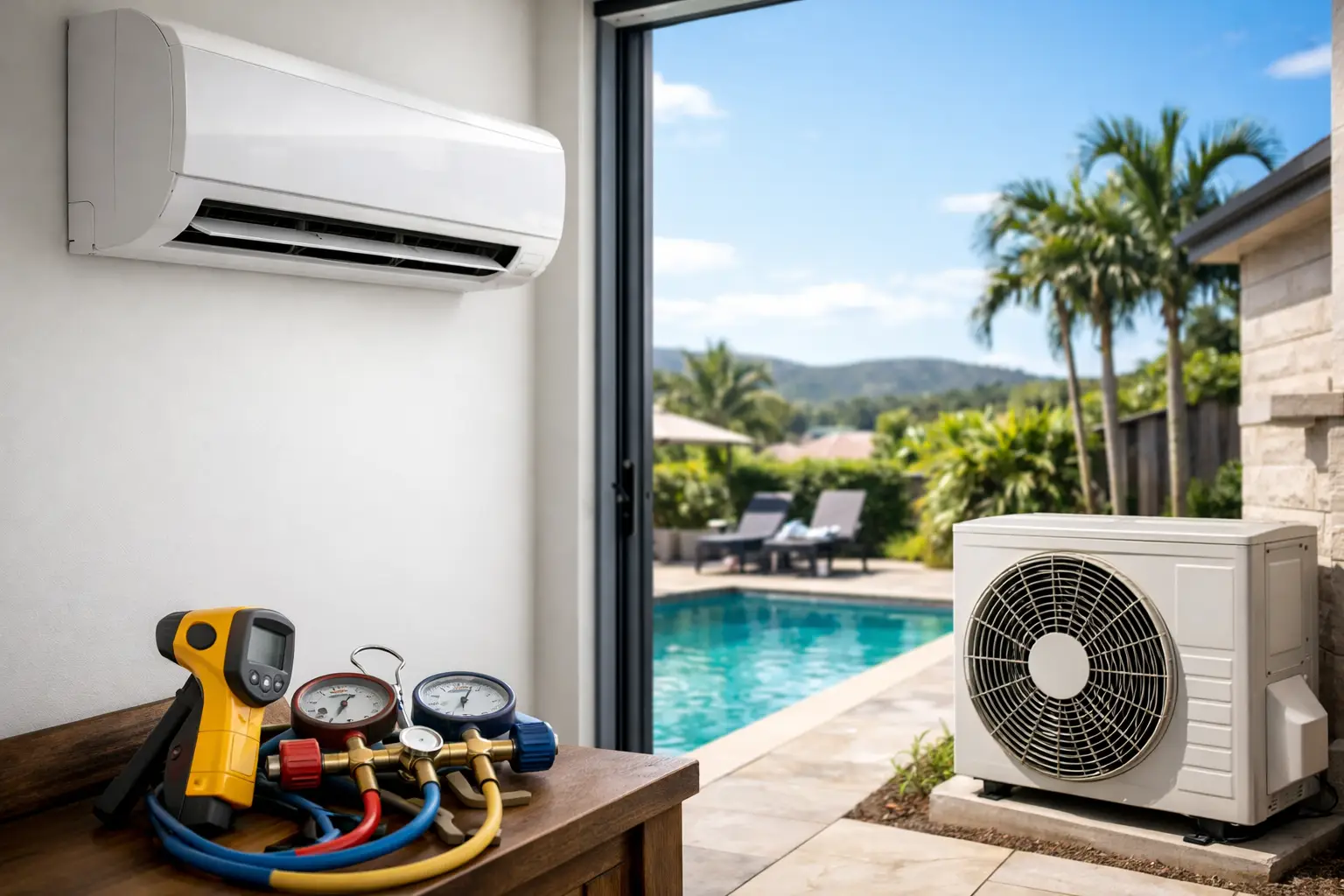
A lounge room that never quite cools down, a bedroom that feels icy at 2am, and power bills that make no sense – that’s usually not just an air conditioner problem. It’s often a sizing problem. This air conditioner sizing guide is here to help you understand what size system your home actually needs, so you can get reliable comfort without paying for the wrong unit.
For homes across the Gold Coast, Southern Brisbane and Tweed Heads, sizing matters more than many people realise. Our climate puts air conditioning systems to work for long stretches, especially through humid summers. If the unit is too small, it will run hard and still struggle. If it’s too large, it can cool the room too quickly without properly removing humidity, leaving the space feeling clammy rather than comfortable.
Why an air conditioner sizing guide matters
A lot of homeowners understandably start with square metre figures. That’s a useful starting point, but it’s not the whole story. Two rooms with the same floor area can need very different air conditioner capacities depending on ceiling height, insulation, window size, afternoon sun, and how the room is used.
That’s why online size charts can be helpful, but only up to a point. They give a rough estimate. Proper sizing is about heat load, not just room dimensions. In plain terms, that means working out how much heat the system needs to remove from the space under real conditions.
Getting that right helps with more than comfort. It can also improve efficiency, reduce wear on the system, and give you a better result from day one.
The basics of air conditioner sizing
In Australia, residential air conditioners are generally sized by kilowatts, not by a vague label like small, medium, or large. The cooling capacity tells you how much heat the system can remove. As a rough guide, a small bedroom might suit a system around 2.5kW, while a larger living area could need 5kW, 7kW or more.
But rough guides stay rough for a reason. A shaded bedroom in a well-insulated home is very different from a west-facing main living room with large glass doors and a high ceiling. Even the number of people regularly using the room can change the recommendation.
If you’re replacing an old unit, it’s also worth knowing that matching the previous size isn’t always the right move. The old system may have been oversized, undersized, or installed before renovations changed the room’s thermal load.
Room size is only the starting point
When people look for an air conditioner sizing guide, they usually want a simple answer. Fair enough. The challenge is that home comfort is rarely one-size-fits-all.
Floor area gives you a baseline, but installers also look at ceiling height. A room with standard ceilings is easier to cool than one with raked or extra-high ceilings because there’s simply more air volume to manage.
Windows make a big difference too. Large panes of glass, especially on western and northern sides, can bring in serious heat. If the room gets hammered by afternoon sun, the system will need to work harder than it would in a shaded part of the house.
Insulation matters in the same way. Good ceiling and wall insulation can help keep conditioned air where it belongs. Older homes, or homes with poor sealing around doors and windows, often lose cooled air faster, which increases demand on the unit.
Then there’s how the room is used. Kitchens generate more heat than spare bedrooms. Open-plan living areas often need more capacity because the cooled air can drift into adjoining spaces. If the system has to fight cooking heat, people coming and going, and constant door opening, size becomes even more important.
What happens if the unit is too small
An undersized system usually shows itself pretty quickly. It runs for long periods, struggles on very hot days, and may never get the room to the temperature you’ve set. That constant effort can mean higher running costs and more strain on the components over time.
There’s also the comfort factor. If the unit is always working flat out, some parts of the room may stay warm while others cool unevenly. You end up chasing the thermostat and still not feeling comfortable.
This is common when people choose a cheaper, smaller unit thinking they’ll save money upfront. Sometimes they do at purchase time, but not in long-term performance.
What happens if the unit is too large
Bigger isn’t always better. An oversized air conditioner can cool the room too quickly and shut off before it has properly dehumidified the air. In a humid Queensland climate, that can leave the room feeling damp or sticky even though the temperature number looks right.
Short cycling is another issue. That’s when the unit turns on and off more frequently than it should. Over time, that can reduce efficiency and increase wear. It may also create more noticeable temperature swings, which is the opposite of the steady comfort most people want.
Oversizing can also mean paying more than you need to for the unit itself and for installation.
Split system sizing versus whole-home thinking
If you’re cooling a single room, sizing is more straightforward. But many homes aren’t that simple. A family might want the main bedroom cooled overnight, the living room comfortable in the afternoon, and perhaps a home office usable through the day.
That’s where planning matters. Sometimes one larger system in the main living area plus a smaller bedroom unit makes more sense than trying to force one unit to do too much. In other homes, a ducted system may be worth considering if the goal is broader coverage and zoned control.
The right answer depends on how you live in the home, not just the floor plan. A good installer will ask which rooms you actually use, at what times, and what matters most – lowest upfront spend, best efficiency, or whole-home comfort.
Installation affects sizing outcomes too
Even the right-sized unit can disappoint if it’s installed poorly. Indoor unit placement, outdoor unit location, pipe run length, airflow direction, and drainage all affect performance.
For example, a system mounted where airflow is blocked won’t distribute cool air properly. An outdoor unit in a poor location may run less efficiently. That’s why sizing and installation should never be treated as separate decisions.
This is also one reason homeowners often prefer dealing with one dependable company instead of juggling quotes, installers and conflicting advice. Clear recommendations, fixed pricing and proper installation make the whole process easier.
When online calculators help – and when they don’t
Online calculators can be useful if you’re early in the process and want a ballpark idea. They’re handy for narrowing down whether you’re likely looking at a small bedroom unit or something much larger for a living space.
Where they fall short is nuance. Most calculators don’t properly account for insulation quality, local orientation, glazing, shading, occupancy patterns or the realities of open-plan layouts. They can point you in the right direction, but they shouldn’t be the final word.
If you want fewer surprises after installation, an in-home assessment is usually the better call.
A practical air conditioner sizing guide for homeowners
If you’re trying to make a sensible shortlist before booking, start with the room dimensions, then consider the factors that push sizing up or down. High ceilings, large sunny windows, poor insulation, open layouts and heat-generating appliances all increase demand. Shaded rooms, smaller windows and good insulation can reduce it.
It also helps to think about your comfort expectations. Do you want the room cooled quickly after work, or maintained steadily all day? Is the system mainly for sleeping, entertaining, or regular daytime use? These details affect what will feel right in practice, even when two units both look suitable on paper.
And if you’re stuck between two sizes, don’t guess based on price alone. A professional recommendation is usually cheaper than replacing the wrong unit later.
The best next step if you want it done properly
For most homeowners, the smartest move is simple: get the room assessed by a licensed professional who installs systems in local conditions every week. They can factor in the things charts miss and give you a recommendation that fits the home, the layout and the way your household actually lives.
That local knowledge matters. Homes near the coast, older brick homes, modern builds with large glazing, and renovated spaces can all behave differently in summer. A fast, fixed-quote process with straightforward advice takes the stress out of choosing.
If you’re investing in air conditioning, the goal isn’t just to buy a unit. It’s to get a system that keeps the space comfortable on the days you really need it, without turning the whole job into a hassle.