


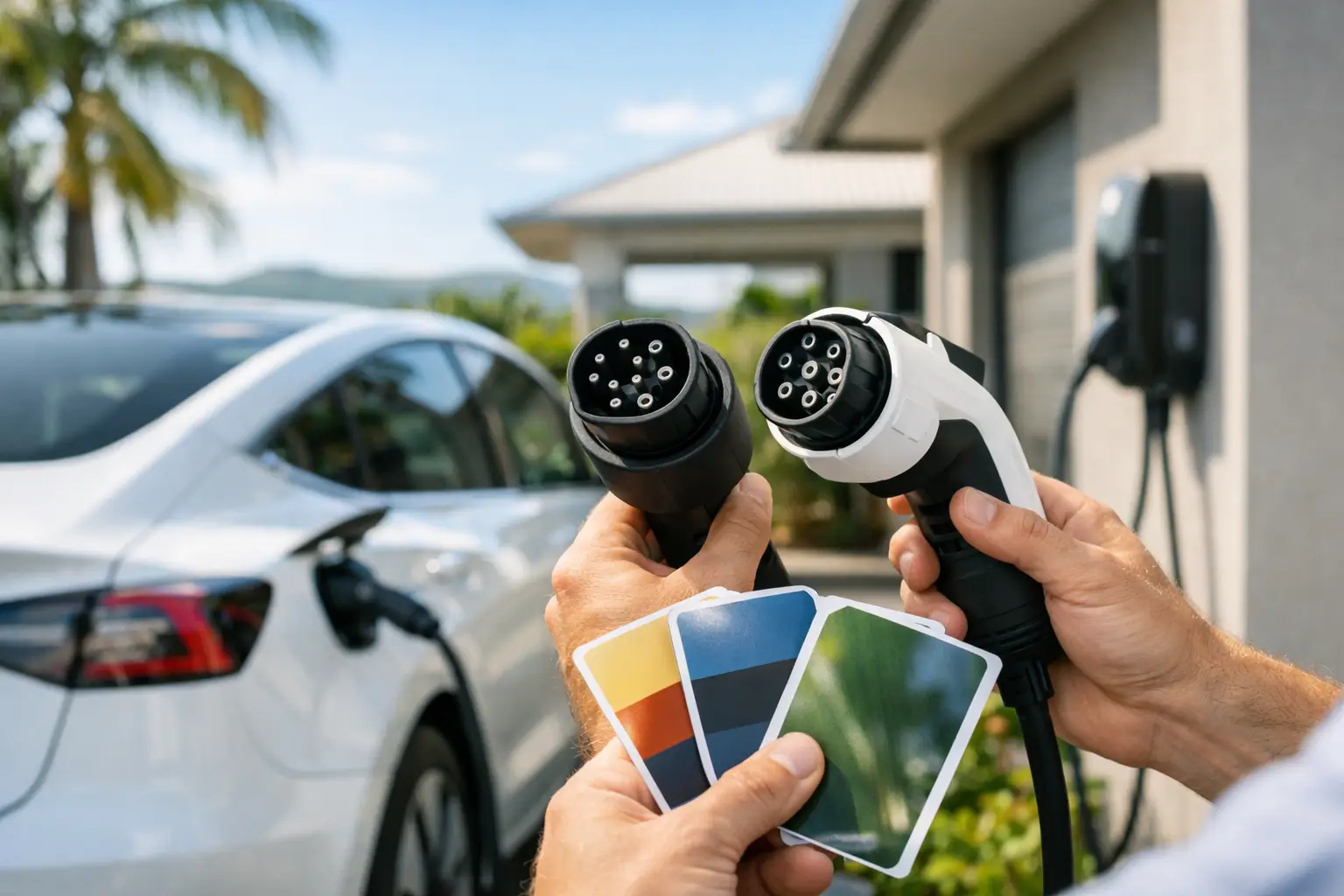
Most people start looking at chargers after one annoying week of ownership – slow charging from a standard powerpoint, cables left everywhere, and a battery that is never quite where you want it by morning. If you are working out how to choose home EV charger options for your place, the right answer usually comes down to three things: how you use your car, what your home can support, and how much future-proofing you actually need.
A home charger is not just a box on the wall. It is part of your home’s electrical setup, your daily routine, and your long-term running costs. Get it right and charging becomes easy. Get it wrong and you can end up paying for features you will never use, or installing something that does not suit your switchboard or vehicle.
How to choose home EV charger without overpaying
The easiest mistake is assuming the biggest charger is the best charger. For many households, it is not.
If your car is parked at home overnight for 10 to 12 hours, you may not need the fastest unit available. A charger that comfortably tops up your usual daily driving is often enough. For example, if you mostly do school runs, commuting and local errands around the Gold Coast, a moderate charging speed can be more practical than paying extra for maximum output you rarely use.
Where faster charging does make sense is when your driving is less predictable. If you do long distances, have more than one EV in the household, or need quick turnarounds between trips, a higher-capacity charger can save frustration. The trick is matching the charger to your real usage, not the brochure.
Start with your car and your driving habits
Before comparing brands or features, look at your vehicle. Not every EV can accept the same charging rate, so there is no point installing a charger your car cannot fully use.
Your vehicle’s onboard charger determines how much AC charging power it can take from a home wall charger. Some cars will happily charge at higher rates, while others are capped lower. That means a more expensive unit will not always charge the car any faster.
Then think about your week. A household driving 40 kilometres a day has very different needs from a household doing regional trips, airport runs and back-to-back errands. If your EV is usually sitting in the driveway overnight, time is on your side. If you need flexibility during the day, charger speed matters more.
It is also worth considering whether this is your only EV. Plenty of households start with one electric car and add a second later. If that seems likely, it can be worth choosing a charger and circuit with that in mind, even if you do not go all the way to a high-end setup now.
Your home’s power supply matters just as much
A charger is only as good as the electrical setup behind it. This is where a proper site assessment matters.
One of the biggest factors is whether your property has single-phase or three-phase power. Many homes have single-phase, which can still support effective overnight charging. Some larger or newer homes have three-phase, which can allow faster charging if the vehicle supports it. That does not automatically mean you need three-phase charging, but it gives you more options.
Your switchboard capacity is another piece of the puzzle. If the board is already busy with air conditioning, electric hot water, pool equipment or other major appliances, the charger needs to be planned carefully. In some homes, a straightforward installation is possible. In others, switchboard upgrades or load management may be the smarter and safer path.
That is why the best answer to how to choose home EV charger systems is not only about the charger itself. It is also about what your home can safely handle without nuisance tripping or expensive surprises later.
The right charger size depends on your routine
There is no single best charger size for every household.
A lower-capacity charger may be perfectly suitable for drivers who charge overnight and cover average daily distances. It is often more affordable to buy and install, and for many people it keeps the car ready without any fuss.
A mid-range option suits a lot of homes because it balances speed, cost and compatibility. It is often the sweet spot for busy families and professionals who want reliable overnight charging with a bit more flexibility.
Higher-capacity chargers are more appealing when charging windows are shorter or vehicle demand is higher. They can also make sense if you are building or renovating and want a stronger long-term setup. But they are not automatically the most economical choice once installation requirements are factored in.
In plain terms, faster is helpful, but only if you actually need it.
Smart features are useful, but only some are worth paying for
A lot of chargers now come with apps, scheduling, Wi-Fi connectivity and usage tracking. Some of these features are genuinely handy. Some are just marketing.
Scheduling can be useful if you want to charge during off-peak periods or line up charging with your solar generation. Usage monitoring is handy if you want to keep an eye on electricity costs or separate household charging between drivers.
Load management is one of the more practical smart features. It helps the charger adjust power use based on what the rest of the house is doing, which can be very helpful in homes with limited electrical capacity. This can sometimes avoid more extensive upgrade work.
If you have rooftop solar, ask whether the charger can work intelligently with solar output. That can improve day-time charging efficiency, especially for people who work from home or have flexible schedules.
But if you simply want to plug in at night and wake up with charge in the morning, you may not need every connected feature under the sun. Reliability often matters more than fancy extras.
Installation quality matters more than the logo on the box
Home EV charging is not a DIY job and it is not something to hand to the cheapest option without asking questions. Safe installation matters just as much as the charger brand.
A proper installation should consider cable run length, weather exposure, mounting location, switchboard suitability and everyday convenience. The charger needs to be easy to access, protected from damage, and positioned so charging your car does not become awkward every day.
Outdoor installation is common, but the equipment needs the right weather protection and placement. Garage installs can be tidier, but only if the cable length and parking position actually work. A charger mounted in the wrong spot can be irritating every single day, even if the electrical work is technically fine.
This is where using one dependable provider helps. Instead of juggling separate advice from suppliers and tradies, you can get a clear recommendation based on your vehicle, home and budget. For local homeowners, that kind of straightforward service saves time and avoids the usual run-around.
Think about the full cost, not just the charger price
A low sticker price can be misleading. The real cost includes the charger, installation, any switchboard work, protective devices, cabling and site-specific labour.
That is why fixed quotes matter. You want to know what is included before work starts, especially if your charger location is a fair distance from the switchboard or your home needs additional electrical work. Transparent pricing makes comparing options much easier.
Sometimes a slightly more expensive charger paired with a clean, suitable install is better value than a cheaper unit that creates complications. Other times, a simpler charger is the smartest financial choice because it covers your daily needs without stretching the budget.
The right choice is usually the one that gives you reliable charging at home without making the installation more complex than it needs to be.
How to choose a home EV charger for the next few years
A good charger should suit you now, but it should also make sense a few years from now. That does not mean buying the most advanced model available. It means thinking realistically.
If you are likely to stay in the home, upgrade to a second EV, add solar, or renovate the garage, some level of future planning is worthwhile. If your current setup is temporary or your driving needs are modest, keeping things simpler may be the better call.
For many households across the Gold Coast, Southern Brisbane and Tweed Heads, the best setup is the one that blends into normal life. Easy charging, safe installation, clear pricing, and no mucking around. That is usually what people mean when they say they want a hassle-free charger – not the most technical option, just the right one.
If you are unsure where to start, begin with your car, your switchboard and your daily routine. The rest gets a lot clearer once those three line up. And when charging at home feels easy from day one, you will know you chose well.