


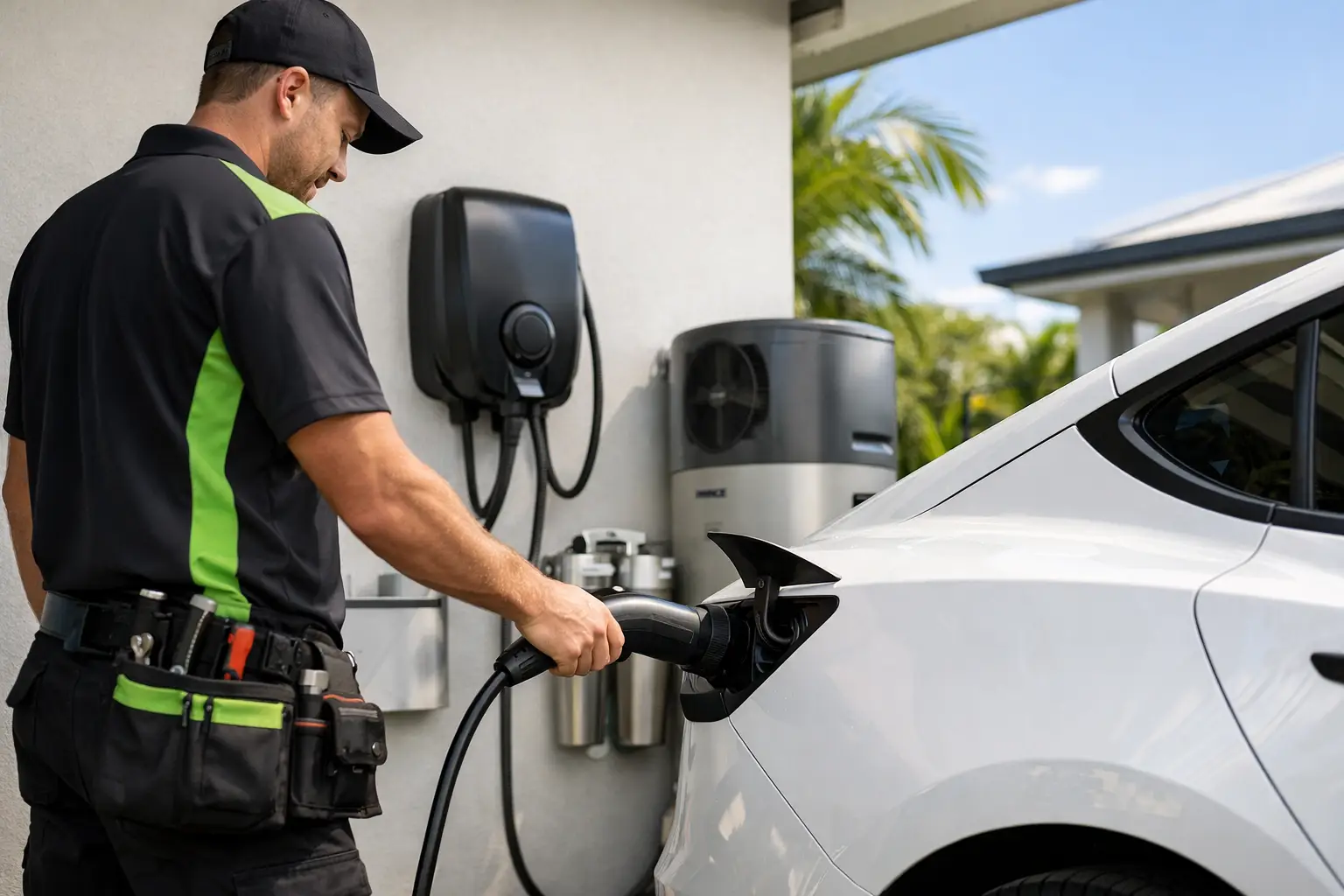
Most homeowners start looking into EV charging after the same moment – the novelty of public chargers wears off, and waiting around for your car to top up starts feeling like wasted time. A proper guide to residential EV charging helps you sort out what matters at home: how fast you need to charge, what your switchboard can handle, and whether the setup will still suit you in a few years.
For most households, home charging is less about having the fanciest unit on the wall and more about making daily life easier. You want to plug in, wake up to useful range, and know the installation has been done safely by a licensed electrician. That is the real goal.
What this guide to residential EV charging should help you decide
The big question is not simply, “Do I need a charger?” It is, “What type of charging setup makes sense for my home and driving habits?” That depends on how far you drive, when the car is usually parked, and what electrical capacity your property already has.
If you only do short local trips and your EV sits in the garage overnight, a basic charging arrangement may be enough. If you have a larger battery, a long commute, two EVs, or a habit of coming home late and heading out early, a dedicated wall charger usually becomes the better option.
There is also the property side of the decision. Older homes can need switchboard upgrades or extra electrical work before a charger goes in. Newer homes are often simpler, but not always. Cable run length, parking layout, and whether the charger will sit indoors or outdoors all affect the job.
The difference between a standard powerpoint and a wall charger
A standard powerpoint can charge an EV, but it is slow. For some households, that is perfectly fine. If your weekly driving is low and the car has plenty of time to recharge, slower charging may cover your needs without a major setup.
The trade-off is convenience. Charging from a normal powerpoint can take a very long time, and those outlets are not designed with regular high-load EV charging as their main purpose. It can work, but it is not always the best long-term solution for safety, speed, or day-to-day ease.
A dedicated wall charger is faster, more purpose-built, and usually more practical for regular EV use. It gives you better control over charging times and can make ownership feel much simpler. Instead of planning around charging, charging starts fitting around your life.
That does not mean every home needs the highest-capacity charger available. In plenty of cases, a moderate setup is the smart choice because it suits the household’s electrical supply and still comfortably covers daily driving.
When a basic setup might be enough
If you drive short distances, have one EV, and can leave the car plugged in overnight most nights, slower charging may be workable. It can also be a sensible short-term option if you have just bought an EV and want to learn your charging habits before paying for a dedicated charger.
When a wall charger usually makes sense
If you rely on the car every day, drive longer distances, or simply do not want charging to become another thing to think about, a wall charger is often worth it. It is especially useful for busy households where convenience matters just as much as charging speed.
Charging speed is only part of the story
A lot of people focus on kilowatts first, but charger speed is not the whole decision. Faster sounds better, but only if your car can use that speed and your home can support it without unnecessary upgrades.
Some households pay extra for charging capacity they rarely use. Others underestimate what they need and end up frustrated later. The better approach is to match the charger to your real usage. Ask how many kilometres you typically drive, how long the car sits parked, and whether your next vehicle is likely to have a larger battery.
Your electricity tariff also matters. If you can charge mostly overnight, a well-chosen home setup can be easier on your running costs than relying on public charging. But if your home has limited electrical capacity, the cheapest path upfront may not be the best if it causes headaches later.
Electrical capacity, switchboards and why installation matters
This is where a lot of online advice gets too simple. Installing an EV charger is not just a matter of mounting a unit and plugging it in. The condition of your switchboard, available circuit capacity, cable route, and safety compliance all come into play.
In some homes, installation is straightforward. In others, the charger itself is only part of the job. You may need a dedicated circuit, protection devices, or a switchboard upgrade. If the charger is going a long way from the main board, labour and materials can also increase.
That is why fixed-price quotes are so valuable. Homeowners want to know what the whole job involves, not just the cost of the box on the wall. A licensed installer should assess the property properly and explain any extra work before installation day, not halfway through the job.
Older homes need a closer look
Older properties can still be excellent candidates for EV charging, but they often need more careful assessment. The wiring may be dated, the switchboard may not have enough room, or the layout may make cable runs more complex.
None of that means the job cannot be done. It just means the right answer depends on the home, not a generic online price guide.
Choosing the right location for your charger
Where the charger goes affects both cost and convenience. The best position is usually close to where the vehicle parks, with a practical cable path and protection from unnecessary wear.
Garage installations are often the simplest, but outdoor installations can work very well when the equipment is rated for it and the placement is sensible. You want easy access without creating a trip hazard, stretching cables across walkways, or forcing awkward parking every time you come home.
Think about how you actually use the space. If one side of the garage is packed with storage or your second car often blocks access, a technically possible location may still be a poor choice in real life.
Smart charging features – useful or just extra cost?
Some EV chargers come with app control, scheduling, usage tracking, solar integration, and load management. These features can be genuinely useful, but not everyone needs all of them.
Scheduling is handy if you want to charge during off-peak periods. Load management can be valuable if your home has limited electrical capacity and you want the charger to work more intelligently with other appliances. Solar compatibility may appeal if you are aiming to use more of your daytime generation.
But there is a difference between useful and overcomplicated. If you want a simple setup that works every day without fuss, a straightforward charger may be the better fit. Good advice is about choosing what you will actually use, not paying for features that sound impressive on paper.
Costs in a residential EV charging setup
The charger unit is only one part of the total cost. Installation can vary depending on the home, and that is where broad price claims often fall apart.
A simple installation in a modern home with a nearby switchboard is very different from a job that needs a longer cable run, outdoor mounting, switchboard work, or additional protections. If you are comparing quotes, make sure you are comparing the full scope. A cheaper figure upfront can become expensive if key items were never included.
It also helps to think beyond installation day. A well-installed charger that suits your home and usage is usually better value than a bargain setup that frustrates you, charges too slowly, or needs rework later.
A few local factors worth considering
For homeowners across the Gold Coast, Southern Brisbane and into Tweed Heads, EV charging choices are often shaped by practical home layouts. Carports, outdoor parking, and homes with a mix of older and newer electrical systems are common, so there is no one-size-fits-all answer.
That is where using one dependable provider can make life easier. If your home needs electrical work as part of a broader upgrade plan, it helps to deal with a team that understands residential systems properly and gives clear, upfront advice.
Common mistakes homeowners make
The most common mistake is choosing based on charger speed alone. The second is assuming every home can take the same installation without issue. The third is treating EV charging like a DIY convenience item rather than a fixed electrical installation.
A better approach is to start with how you live. How often do you drive? How long is the car parked? Will you keep one EV or likely add another? Do you want the simplest setup possible, or are smart features worth it for your household?
Those answers usually point you in the right direction faster than browsing charger specs for hours.
If you are planning ahead, think of your charger as part of the way your home works day to day – much like hot water, air conditioning or cooking appliances. When it is chosen well and installed properly, it stops being a project and just becomes one less thing to worry about.