


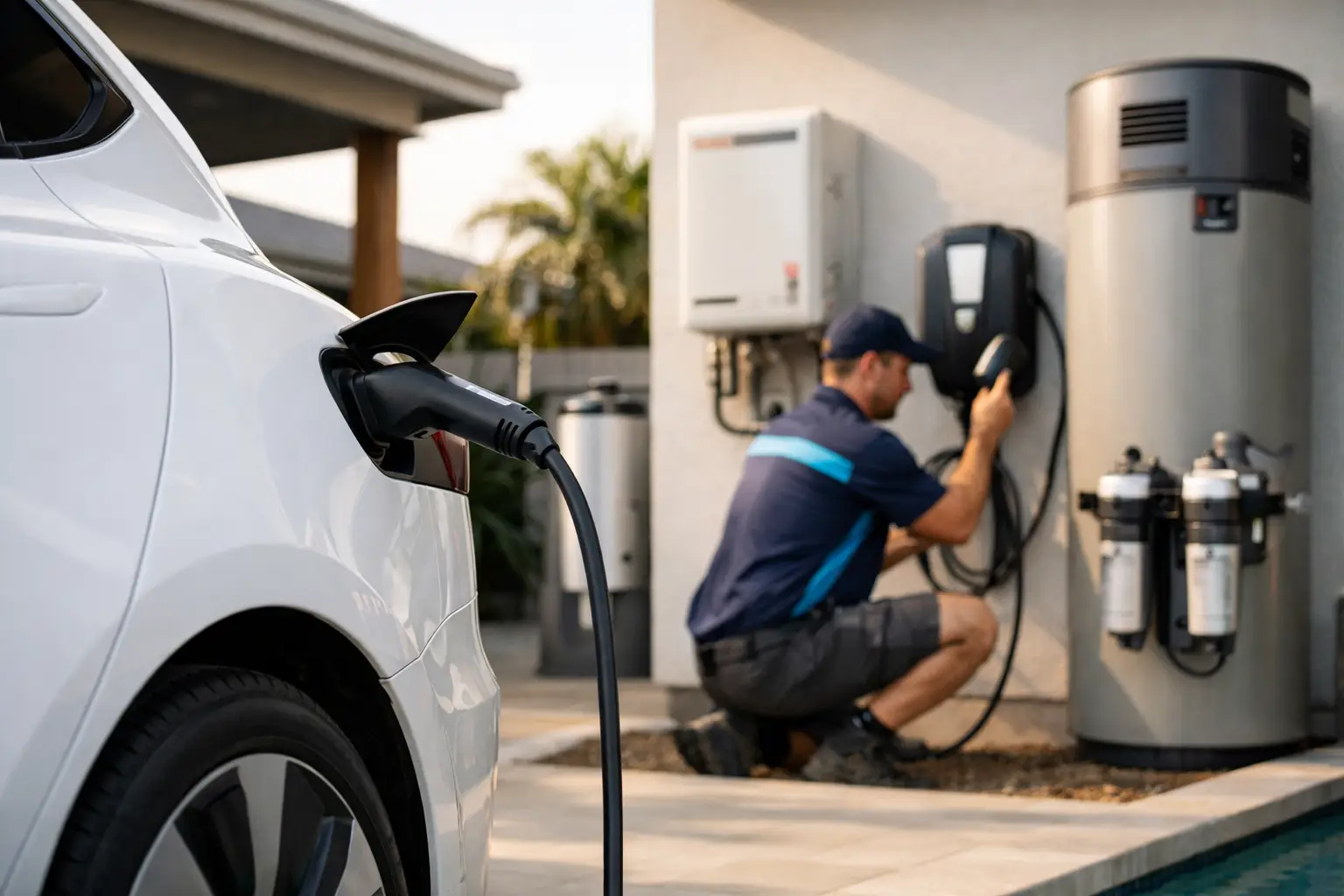
A home EV charger should fit the way you actually use your car, not just be the biggest unit on the shelf. If you are asking, what size ev charger do i need, the answer usually comes down to three things: how far you drive, how long the car is parked at home, and what your home’s electrical supply can safely support.
For many Gold Coast and Tweed homeowners, a 7kW charger is the practical sweet spot. It comfortably replenishes most daily driving overnight without the added cost and electrical work that may come with a larger three-phase setup. But there are situations where 11kW or 22kW charging makes sense.
What size EV charger do I need at home?
Most homes are best served by a 7kW AC wall charger on single-phase power. It charges far faster than a standard power point while remaining a realistic option for many existing homes.
As a rough guide, a 7kW charger can add around 35 to 45 kilometres of driving range per hour. Leave the car plugged in from dinner until morning and it can often recover a full day’s driving with room to spare. Exact results vary with the vehicle, battery condition, charging settings and energy losses.
An 11kW or 22kW charger can charge more quickly, but only when all parts of the setup support it. That means your property generally needs three-phase power, your switchboard and supply capacity need to be suitable, and your vehicle must be able to accept that charging rate. Installing a 22kW unit does not mean every EV will charge at 22kW.
The usual home charging sizes
A 2.3kW portable charger plugs into a regular socket and is sometimes called a granny charger. It can be useful as a temporary option or for very low daily kilometres, but it is slow. A larger battery may take well over a day to fully recharge, and regular long-term use from a standard socket should be discussed with a licensed electrician.
A 7kW wall charger is typically connected to a dedicated 32-amp circuit on single-phase power. It is the common choice for households that drive most days and want dependable overnight charging.
An 11kW charger generally needs three-phase power and draws around 16 amps on each phase. It suits homes with three-phase supply where the vehicle can accept 11kW AC charging and quicker turnaround is genuinely useful.
A 22kW charger also needs three-phase power, usually with greater electrical capacity. It can be a good fit for some high-use households, properties with multiple EVs, or homes where cars need to be recharged in a shorter window. For plenty of households, though, it is more capacity than they need.
Start with your daily kilometres, not the battery size
Battery capacity matters, but daily driving is usually the better place to start. A family driving 40 to 80 kilometres a day does not need to refill an entire battery every night. Even a 7kW charger will generally replace that energy in a few hours.
For example, if your EV uses roughly 18kWh per 100 kilometres and you travel 60 kilometres in a day, you will use about 11kWh. A 7kW charger can usually put that back in around two hours, allowing for some charging losses. If the car sits in the driveway for 10 or 12 hours overnight, a larger charger may not change your day-to-day experience at all.
A faster charger starts to make more sense when you do longer trips several times a week, regularly arrive home with a low battery, operate a business vehicle, or need to share charging between two EVs. It can also help if your available charging window is short, such as a car that arrives home late and leaves again early.
Check the EV’s onboard charger limit
The wall charger supplies power, but the car decides how much AC power it can take. This is one of the most commonly missed details when choosing a charger size.
Some EVs accept a maximum of around 7kW on AC, even when connected to an 11kW or 22kW charger. In that case, a larger unit will not make that particular car charge faster. Other models can accept 11kW, while a smaller number can take 22kW AC charging.
Your vehicle handbook, manufacturer specifications or dealer can confirm the maximum AC charging rate. Check this before comparing charger models. It protects you from paying for capacity your current car cannot use, while still allowing you to weigh up whether future vehicle plans justify a larger installation.
Do not confuse AC home charging with DC fast charging at public charging stations. A home wall charger is usually an AC charger. It is designed for convenient, regular charging at home rather than the high-speed top-ups available at selected public sites.
Your home’s power supply is just as important
The right charger size is not decided by the car alone. Your electrician needs to assess the home’s existing electrical supply, main switchboard, available circuit capacity, earthing and cable route to the parking area.
A house with single-phase power can often accommodate a 7kW charger, subject to a proper load assessment. However, air conditioning, electric hot water, pool equipment, cooking appliances, solar equipment and other major electrical loads all need to be considered. The goal is safe charging without overloading the home supply.
Three-phase power opens the door to 11kW and 22kW charging, but it does not automatically mean the highest rate is the best buy. A switchboard upgrade, supply upgrade, longer cable run or difficult access can affect the final installation cost. A fixed quote after an on-site assessment gives you a clearer picture than choosing a charger by price alone.
Smart load management can change the answer
Some smart chargers can use load management to monitor household demand and reduce charging power when other large appliances are running. When demand drops, charging can increase again.
This can be particularly useful in homes with air conditioning, pools or electric hot water, and it may avoid the need for a costly supply upgrade in some situations. It does mean the car may not always charge at its maximum advertised rate, but for overnight charging that is often a sensible trade-off.
Smart features can also let you schedule charging for off-peak electricity periods, track energy use and control charging from a mobile app. If you have solar, a compatible charger may help you make better use of daytime solar generation. Whether that suits you depends on when the car is usually at home. A car parked at work all day will not benefit from solar-only home charging in the same way as a car at home during daylight hours.
Think about tomorrow, but do not overbuild
Choosing for your next vehicle can be sensible, especially if you expect to keep the charger for many years. If your current EV is limited to 7kW but you are likely to replace it with an 11kW-capable model, installing an 11kW-ready solution may be worth discussing if your home has three-phase power.
Still, future-proofing should be balanced against real cost. A well-installed 7kW smart charger is a strong long-term choice for a large number of homes. It is safer and more convenient than relying on a standard socket, and it is enough for most overnight charging routines.
If your household has two EVs, consider whether one charger can be shared. A single 7kW charger may work well if both vehicles are parked for long periods or driven on different days. If both cars need substantial charging every night, a second charger or a higher-capacity, managed setup may be a better fit.
A quick way to choose the right size
Choose a 7kW charger if you have single-phase power, drive typical daily distances and can charge overnight. This is the straightforward choice for most homeowners.
Consider 11kW if you have three-phase power, your EV accepts 11kW AC charging and you want a faster overnight or daytime recharge. Consider 22kW only if your car supports it, your electrical supply has the capacity and you have a genuine need for rapid home charging or multiple high-use EVs.
Whatever size you choose, the installation should be completed by a licensed electrician and tailored to your home. No Hassle Homes can assess your parking location, switchboard and charging habits, then provide a clear recommendation and fixed quote. The best charger is the one that gets your car ready when you need it, without adding unnecessary cost or complication.