


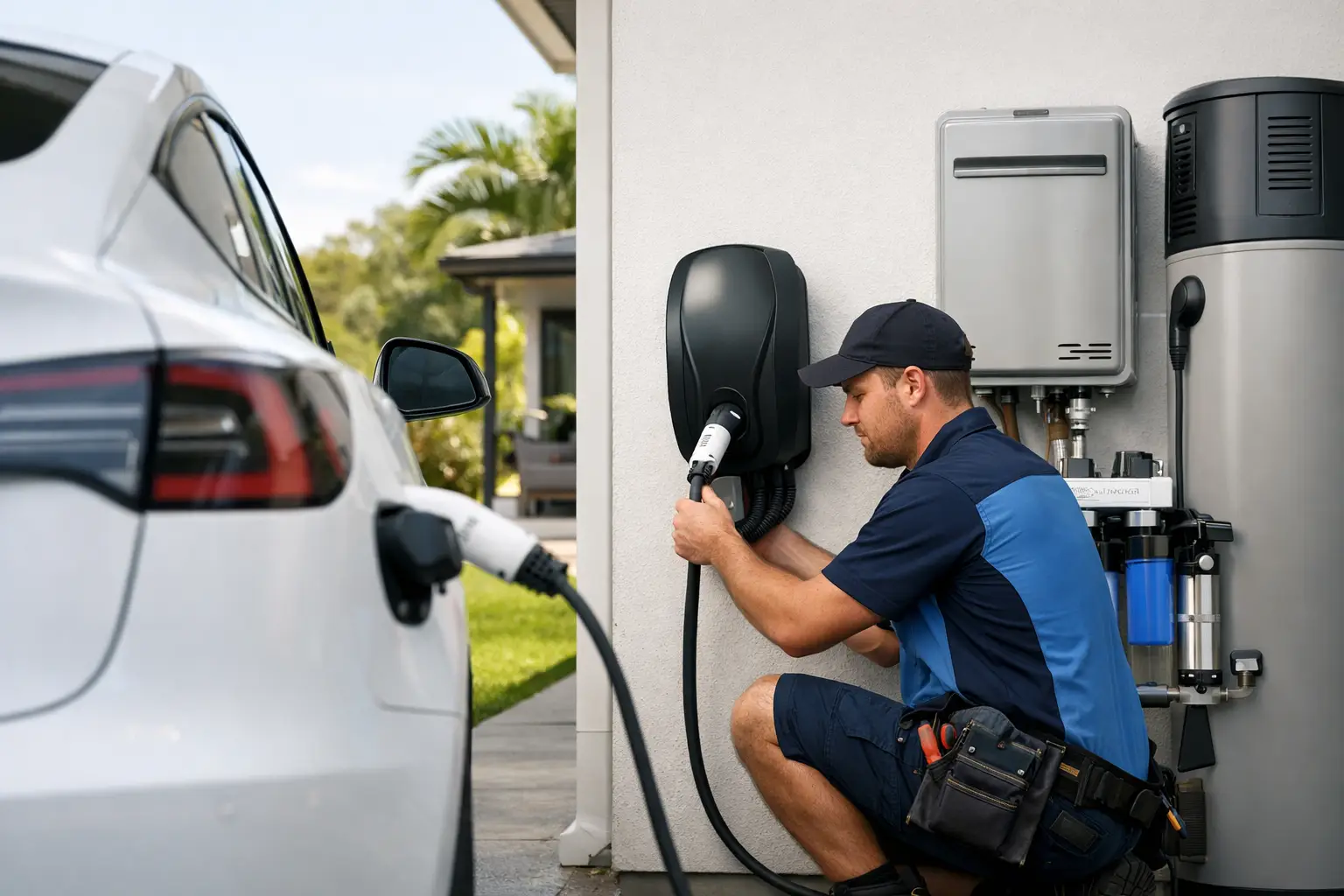
Your new EV may be parked in the driveway, but the charging decision starts inside the house. A home charger needs enough electrical capacity, a sensible cable route and a location that works on a wet Tuesday night – not just on installation day.
Knowing how to prepare for an EV charger before you book helps avoid delays, unexpected electrical work and a charger placed where it is awkward to use. A licensed electrician can assess the final requirements, but a little preparation makes the whole process faster and clearer.
Start with your daily driving and charging habits
The best charger is not necessarily the biggest one available. It is the one that reliably puts enough range back into your vehicle while it is parked at home.
Think about how far you normally drive in a day, when the car is usually home and whether you have one EV now or may add another later. For many households, overnight charging is more than enough. If the vehicle is parked for 10 to 12 hours, a properly selected home charger can comfortably cover typical commuting and family driving needs without needing the highest charging rate.
Your vehicle also sets some limits. Check its maximum AC charging capability, because buying a higher-capacity charger does not make every EV charge faster. The electrician will also consider the electrical supply to your home, the charger’s settings and the other large appliances you use.
It pays to think a few years ahead. If a second EV is likely, or you are planning solar, battery storage, a pool heater, ducted air conditioning or a home generator, mention it during the quote. These systems all draw from the same household electrical supply. Planning them together can prevent doing the same electrical work twice.
Choose the right place before you prepare an EV charger
Most people charge where they park most often: inside a garage, on a carport wall or beside a driveway. The ideal position is practical, protected where possible and close enough that the charging cable reaches the vehicle inlet without being stretched across a walkway.
Walk through your usual parking routine. EV charge ports are not in the same place on every vehicle – they may be at the front, rear or side. Park the car where it will normally sit, then identify where the charger and cable would be easiest to use. A charger that looks neat but requires you to reverse in differently every night can become a daily annoyance.
Keep the cable out of areas where it could become a trip hazard or be damaged by cars, doors or garden equipment. If the charger will be outdoors, it must be suitable for the conditions and installed in a location that manages weather exposure, drainage and physical knocks. Your installer can advise on the appropriate equipment and mounting height.
Also consider access. If the charger is on an external wall, make sure it does not block a gate, narrow a path or create an obstacle near the footpath. For shared driveways, townhouses and apartment parking, approvals and body corporate requirements may need to be sorted before installation can begin.
Check your switchboard and electrical supply
A home EV charger is a significant electrical load. It should not simply be added without checking what else the home needs to run safely.
Take a clear photo of your switchboard with the cover closed and another with it open only if it is safe to do so. This gives the electrician an early view of its size, condition and available space. Older switchboards may need upgrades, extra safety switches or new protection devices before a charger can be connected. That is not a reason to put the project off – it is a chance to bring an essential part of your home’s electrical system up to scratch.
You should also know whether your property has single-phase or three-phase power. Three-phase supply can allow higher charging rates in suitable homes and vehicles, but it is not automatically necessary. A quality installation is based on what your household needs, what the vehicle can accept and what the existing electrical supply can safely support.
Tell your electrician about high-demand equipment already in the home. This includes electric hot water, ovens, induction cooktops, air conditioning, pool pumps, spa heaters and workshop machinery. The aim is to avoid overloading the supply during busy periods, such as when everyone arrives home, turns on cooling and starts cooking dinner.
In some homes, load management is the smart answer. This allows the charger to reduce or pause charging when the rest of the house is drawing heavily, then resume when capacity is available. It can be a practical alternative to a larger electrical upgrade, depending on the property and your charging needs.
Plan the cable route from the switchboard
The distance between the switchboard and charger affects both the scope of work and the quote. A charger mounted on the other side of a garage wall may be straightforward. A charger at the end of a long driveway, in a detached garage or on a front boundary can require trenching, conduit, wall penetrations or more complex cable runs.
Before the site visit, trace the likely route from the switchboard to the parking area. Note any tight roof spaces, concrete paths, retaining walls, gardens, pools or rooms that could affect access. You do not need to solve the route yourself. Simply pointing out these factors early helps the installer recommend the cleanest and safest option.
If trenching across a garden or driveway is needed, ask where the cable will run, how surfaces will be reinstated and whether any underground services need to be located first. Avoid making assumptions about what is buried on your property. Water pipes, gas lines, communications cables and drainage can all be relevant.
A good installation should look considered, not like an afterthought. Sometimes the shortest route is best; other times a slightly longer route produces a tidier finish and protects the cable better. It depends on the building layout and where the charger will be used.
Decide whether solar matters to you
Solar can make daytime EV charging attractive, especially for households where the car is home during work hours. But solar panels do not mean every charging session will be free. Generation changes with weather, season, shading and household use, while an EV can draw more power than the solar system is producing at a given moment.
If solar is part of your plan, tell the installer the size of your system and whether you have a battery. Some chargers can work with solar-aware controls, while others are better suited to scheduled off-peak charging. The right option comes down to your electricity plan, your vehicle’s parking schedule and whether convenience or maximising solar use is your priority.
For many working households, a scheduled overnight charge remains the simplest approach. For others, particularly people home during the day, solar-focused charging may be worthwhile. There is no single setting that suits every home.
Get ready for the installation day
Once you have chosen a charger and accepted a fixed quote, a few simple steps help the job run smoothly. Make sure the electrician can access the switchboard, garage or parking space, and clear boxes, tools and stored items away from the work area. If a vehicle needs to be moved, do that before the appointment.
Have your EV details ready, including make, model and preferred charging settings if you know them. If you rent, own a strata property or need approval for external works, confirm this before booking. It is also useful to ask how the charger will be tested, how you will operate it and what to do if it shows an error.
Only a licensed electrical professional should install or alter EV charging equipment. Portable charging leads have their place for occasional use, but they are not a substitute for a properly designed home charging setup. Avoid relying on extension leads or improvised power arrangements, particularly outdoors.
A charger should make life easier
Preparing for an EV charger is really about removing friction from your routine. With the location, electrical capacity and cable route sorted, you can arrive home, plug in and get on with your evening.
For homeowners across the Gold Coast and surrounding areas, No Hassle Homes can help assess the job, supply the right charger and arrange licensed installation with clear advice from the start. A quick site check now can mean years of safe, convenient charging at home.