


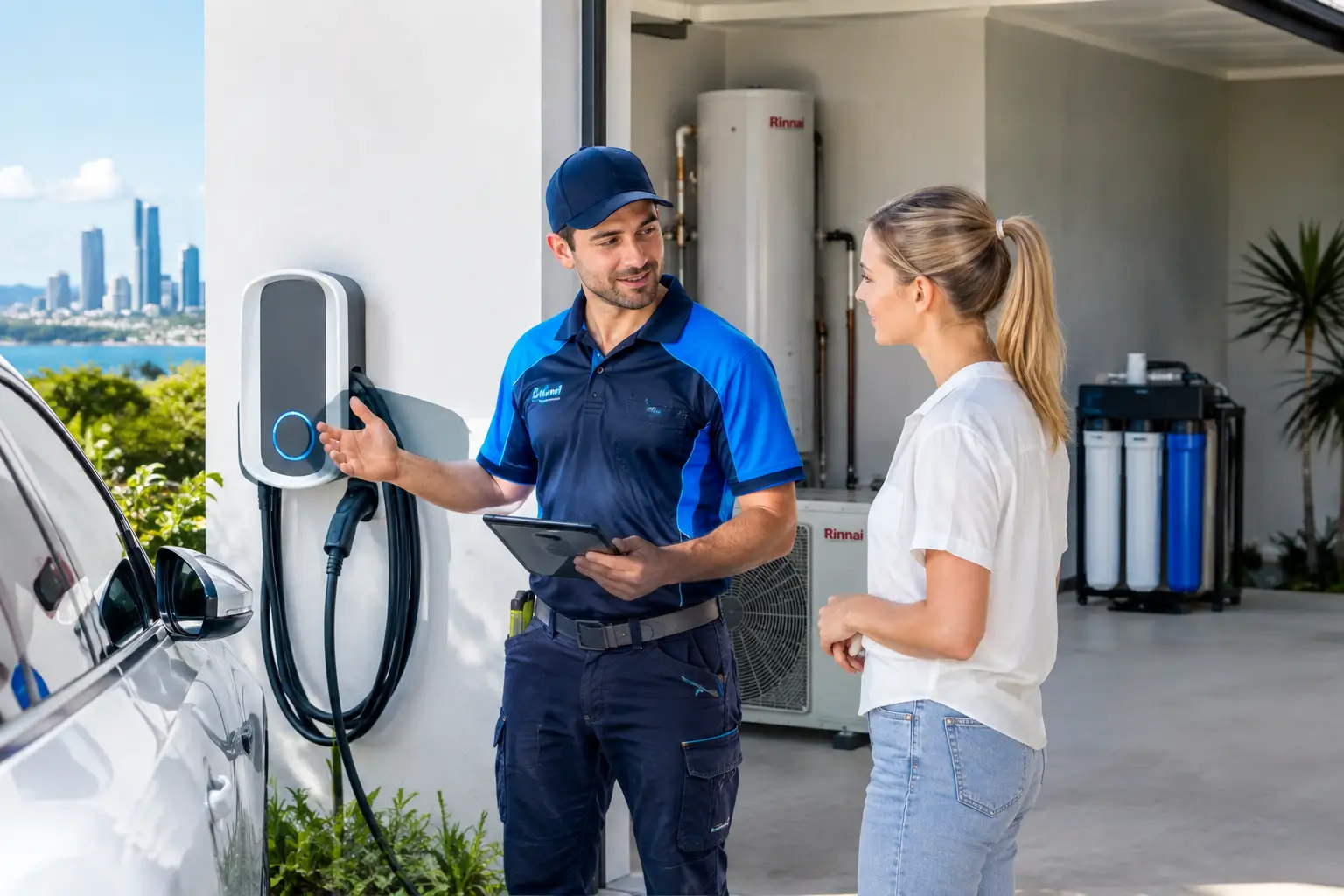
Your EV should be ready when you are. For most households, that means charging at home overnight rather than planning trips around public stations. The right EV chargers make that routine simple, but choosing one is about more than picking a unit from a brochure. Your vehicle, switchboard, parking setup and daily driving all affect what will work best.
A professionally installed home charger can give you faster, safer and more predictable charging. It can also avoid the frustration of a cable that does not reach, a charger that is bigger than your electrical supply can support, or a switchboard that needs attention after installation day.
Start with how you actually use your EV
Before comparing charger features, look at your usual week. A household that drives 30 to 60 kilometres most days has different needs from one that regularly travels between the Gold Coast, Brisbane and northern New South Wales. The goal is not necessarily to buy the fastest charger available. It is to replace the energy you use between drives with enough room for the occasional longer trip.
Most home charging happens while the car is parked for many hours, usually overnight. That gives a 7 kW wall charger plenty of time to suit many homes and EVs. If your vehicle is only parked for a short period, or your household has more than one electric vehicle, a higher-capacity option may be worth considering, provided your home has the electrical supply for it.
It is also worth checking your vehicle’s AC charging limit. Some cars cannot accept the full output of every charger. Installing a 22 kW unit does not make sense if the vehicle or home supply limits charging well below that rate. A qualified installer can help match the charger to the car and your property, rather than selling capacity you will not use.
EV chargers: wall unit or standard outlet?
Many EVs come with a portable charging cable that can plug into a suitable standard power outlet. This can be useful as a backup or for very low daily driving, but it is generally slower than a dedicated wall-mounted charger. It also places a continuous load on the outlet for long periods, which is why the condition and suitability of the circuit matter.
A dedicated EV charger is usually the better long-term choice for regular home charging. It is fixed in place, designed for the job and can provide charging at a higher rate. Features vary by model, but useful options can include scheduled charging, access control, usage monitoring and solar-aware charging.
Smart features are helpful when they solve a real problem. If you want to use lower-cost off-peak electricity or track charging costs for a work vehicle, app controls can be worthwhile. If you simply want to plug in after dinner and wake up to a charged car, a reliable, easy-to-use unit may be the better fit. More features can mean a higher upfront cost, so it pays to focus on the ones your household will genuinely use.
Check your switchboard before choosing charging speed
Your charger is only one part of the system. The electrical supply to your home, switchboard capacity, existing circuits and other major appliances all need to be assessed before installation. Air conditioning, electric hot water, pool pumps, ovens and dryers can create significant demand at the same time as an EV charger.
A licensed electrician should assess the property and recommend the appropriate circuit protection, cabling and charger settings. In some cases, the switchboard may need an upgrade or extra space. This is not a reason to put the project off. It is simply part of getting a safe installation that will perform properly over time.
Load management can be particularly useful in homes with high electricity use. This technology can reduce or pause EV charging when the home is drawing heavy power, then increase charging again when demand drops. It helps protect the overall electrical supply without requiring you to manually manage every appliance.
If your property has three-phase power, you may have more charging options. However, three-phase power is not essential for convenient home charging. Plenty of single-phase homes can support a practical charger that fully covers normal daily driving.
Put the charger where it will be easiest to use
The best charger location is usually close to where the vehicle is parked, with a cable route that is tidy and safe. It should not create a trip hazard across a walkway or leave the cable stretched tightly every time you plug in. Think about where the charging port sits on your current vehicle, but leave some flexibility if you may change cars in the future.
Garages and carports are common choices. Driveway installations can also work well with the right equipment and weather protection. In coastal areas, placement and product selection matter even more. Salt air, sun and heavy rain can be hard on outdoor electrical equipment, so the charger needs an appropriate weather rating and a secure installation.
For strata properties, townhouses or rental homes, you may need approval before work begins. It is better to clarify this early, especially where the charger affects common property, shared parking or electrical infrastructure. A clear plan can prevent delays once you are ready to install.
Consider solar, tariffs and future needs
If you have rooftop solar, EV charging can help you use more of the electricity your panels produce. Some chargers can adjust charging to follow available solar generation, while others allow you to schedule charging during the middle of the day. This can be a good option if the car is home during daylight hours.
For households where the EV is away during the day, overnight charging on an eligible off-peak tariff may make more sense. Electricity plans and tariff structures differ, so check your current arrangement before assuming solar is always the lowest-cost option. The practical answer depends on when your car is at home and how your electricity retailer charges for usage.
It is also sensible to plan for the next few years. You may only have one EV now, but a charger with load management, sensible cable length and room for a second charging point later can save disruption down the track. Future-proofing does not mean paying for every available upgrade. It means avoiding choices that will be difficult or expensive to change.
What a proper EV charger quote should cover
A fixed quote should be clear about what is included, not just the price of the charger itself. Ask whether it covers the charger supply, labour, cable run, circuit protection, switchboard work, testing and compliance documentation. If site conditions could affect the final scope, that should be explained before the work is booked.
A good installer will also ask practical questions: where you park, the make and model of your EV, the location of the switchboard, whether you have solar and whether you expect other large electrical loads to run at the same time. These details help avoid surprises and lead to a setup that suits your household.
Do not be tempted by a shortcut installation from an unlicensed provider. EV charging is a high-load electrical job. Professional installation protects your home, helps maintain manufacturer requirements and gives you confidence that the charger has been tested before you rely on it every day.
Make home charging the easy part of owning an EV
Once the charger is installed, the routine should be straightforward: park, plug in and let the car charge when it makes the most sense for your home. A few minutes spent getting the location, output and installation right can make every trip afterwards easier.
For homeowners who want one dependable team to supply and install EV charging equipment, No Hassle Homes can help assess the job, provide a clear quote and organise a safe, practical installation. The best EV charger is the one that fits your car, your home and your daily life without creating another household headache.