


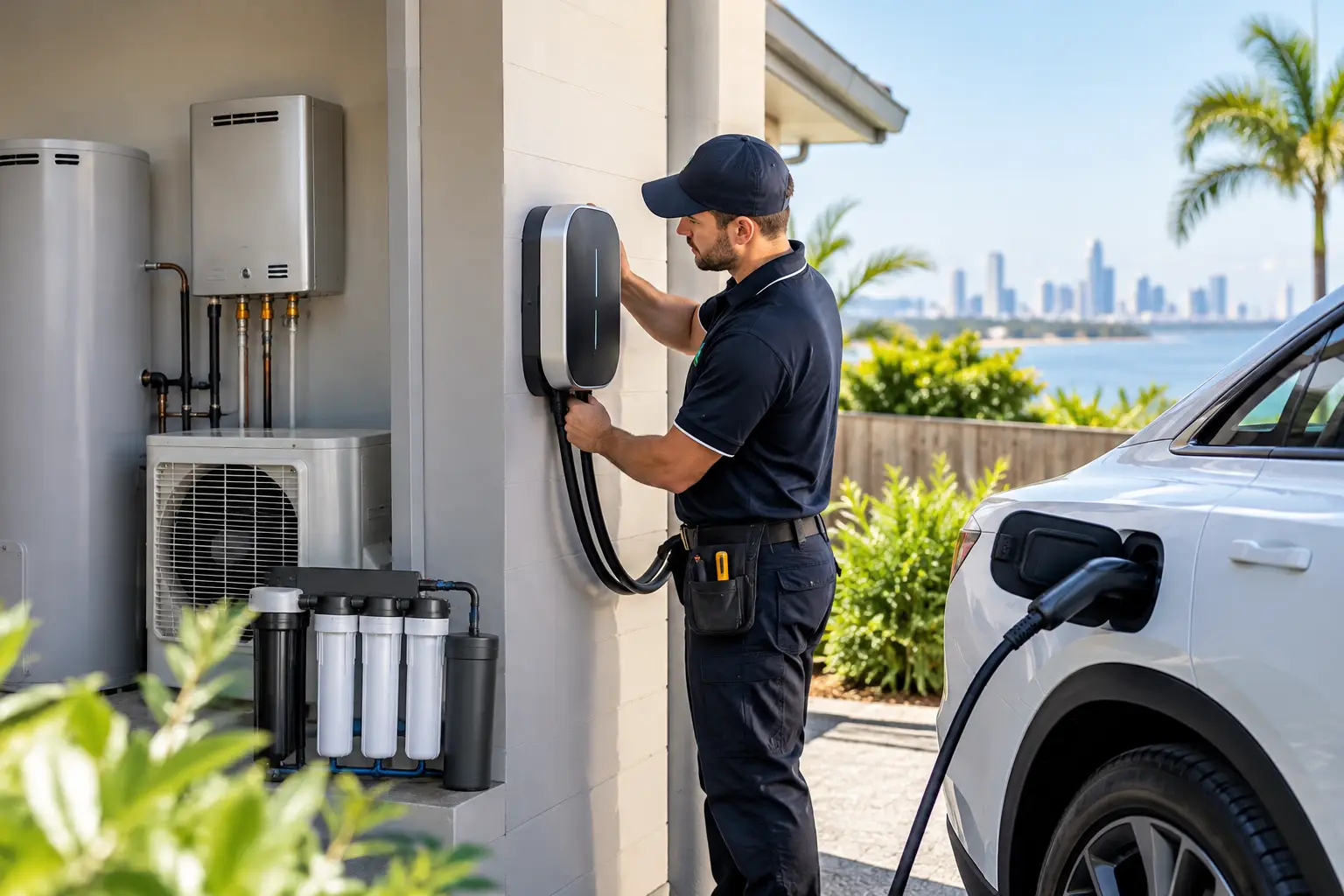
Arriving home, plugging in your car and waking up to a full battery is the simple promise of home charging. Smart EV chargers take that convenience further by giving you more control over when your vehicle charges, how much power it uses and, in some cases, what it costs to run.
For many Gold Coast homeowners, an EV charger is less about fancy technology and more about making daily life easier. The right unit can suit your household routine, work with your electrical supply and help avoid charging at the most expensive times of day. But smart features only add value when they are properly matched to your car, switchboard and energy setup.
What makes an EV charger “smart”?
A standard home EV charger supplies power to your vehicle safely and much faster than a regular wall socket. A smart charger does that job while also connecting to an app, your home network or both. This lets you see charging activity and adjust settings from your mobile.
The exact features differ by model, but smart chargers commonly allow you to schedule charging, track energy use, start or stop a session remotely and set limits for charging. Some can respond to solar generation or electricity pricing. Others can share available power with the rest of the house, reducing the chance of overloading your supply when the air conditioning, oven and other appliances are running.
That does not mean every household needs every feature. If you drive short distances and simply plug in overnight, a reliable charger with basic scheduling may be all you need. If you have rooftop solar, a time-of-use electricity plan or more than one EV, the extra control can make a bigger difference.
Why smart EV chargers can suit busy households
The main benefit is that charging can fit around your life instead of becoming another job to remember. Set a schedule once, plug in when you get home and let the charger do the rest.
Charge when electricity may cost less
Many electricity plans have different rates at different times. A smart charger can be programmed to begin charging during your off-peak window, provided your retailer and plan offer one. This can lower running costs compared with charging whenever you arrive home.
It is worth checking your bill before making assumptions. Off-peak times, rates and demand charges vary between plans. A charger cannot create cheaper electricity on its own, but it can help you use the plan you already have more deliberately.
Make better use of solar power
Solar-aware charging is appealing for households that generate power during the day. Depending on the charger, inverter and system configuration, you may be able to prioritise available excess solar for your EV rather than exporting it to the grid.
There is a practical trade-off. Solar production is highest during daylight hours, while many vehicles are away from home. This feature is most useful if your car is regularly at home during the day, you work from home, or you can top up on weekends. A smart schedule can also combine solar charging during the day with cheaper grid charging overnight when needed.
Keep an eye on energy use
App-based monitoring gives you a clearer picture of how much electricity is going into the vehicle. That can be useful when comparing electricity plans, working out household costs or checking whether a charge completed as expected.
Treat the figures as a helpful guide rather than a full household energy audit. The vehicle’s display, your electricity metre and the charger app may show slightly different numbers because they measure energy at different points.
Help manage household demand
An EV charger is a significant electrical load. Smart load management can reduce or pause charging when your home is using a lot of power elsewhere, then resume when capacity becomes available.
This can be particularly helpful in homes with ducted air conditioning, electric hot water, induction cooking or a pool pump. It may also help avoid a costly electrical upgrade in some situations, although that depends entirely on your existing supply, switchboard and charging requirements. A licensed electrician should assess this before recommending a charger.
Choosing the right charger is not just about the app
The most expensive charger is not automatically the best one. Start with how you use your vehicle. Consider the kilometres you normally drive, how long the car is parked at home, whether you have solar and whether another EV may be added later.
Charging speed matters, but it needs context. A faster charger can be useful for high daily kilometres or households with limited time between trips. For many drivers, however, a moderate charging rate easily replenishes a normal day’s driving while the car is parked overnight. Your vehicle’s onboard charging capability also sets a limit, so buying a higher-rated charger does not always mean your car will charge faster.
Cable length is another small detail that can make a big difference. Think about where the charging port is on your vehicle and where you normally park. The cable should reach comfortably without being stretched across a walkway or driveway.
You will also need to decide between a tethered charger, which has a fixed cable, and a socketed unit that lets you use your own cable. Tethered units are convenient for everyday use. Socketed chargers can offer flexibility if you change vehicles or prefer to keep the cable stored away. Neither option is universally better.
A safe installation starts with the site assessment
A home EV charger should be supplied and installed by a licensed electrician. The job is not simply mounting a box on a wall. Your installer needs to consider the switchboard, available electrical capacity, cable route, protective devices, earthing, parking layout and the charger’s location.
Outdoor installations need suitable weather protection and a position that is practical for everyday use. A charger that is technically compliant but awkward to reach will quickly become frustrating. In coastal areas, choosing equipment and fittings suited to local conditions is also sensible.
A good assessment should identify whether the existing switchboard needs work, whether load management is worthwhile and whether the proposed charging rate is appropriate for the home. Ask for a clear, fixed quote that explains what is included and flags any likely additional work before installation begins.
Do not rely on a standard power point as a long-term substitute for a dedicated charger unless a licensed electrician has specifically advised it is suitable. Regular wall sockets are not designed for prolonged, high-current EV charging in the way a properly installed EV charger is.
Getting the smart settings right
Once installed, spend a few minutes setting up the charger rather than leaving it in default mode. Connect it to the app, install updates when recommended by the manufacturer and set a charging schedule that matches your routine.
If your electricity plan has off-peak periods, schedule charging within those hours. If you use solar, choose a mode that suits when the car is actually at home. It is also sensible to set notifications for charging interruptions, particularly in the first few weeks while you learn how the system behaves.
Keep access secure. Use a strong password for the charger account, protect your home Wi-Fi network and only share app access with people who need it. If you move house or sell the charger with the property, reset ownership and account details properly.
When a simpler charger may be enough
Smart features are useful, but they are not compulsory for safe, convenient home charging. A basic dedicated charger may suit you if your electricity rate is the same all day, you do not have solar, and your car is consistently parked overnight.
The priority should always be a quality unit that is compatible with your vehicle and professionally installed for your home. Smart functions should support that foundation, not distract from it.
For homeowners across the Gold Coast, a practical charger recommendation starts with an honest look at the driveway, electrical setup and daily routine. No Hassle Homes can help make that process straightforward, from selecting a suitable charger to arranging licensed installation. The best system is the one that quietly gets your car ready for tomorrow without adding another hassle to your day.