


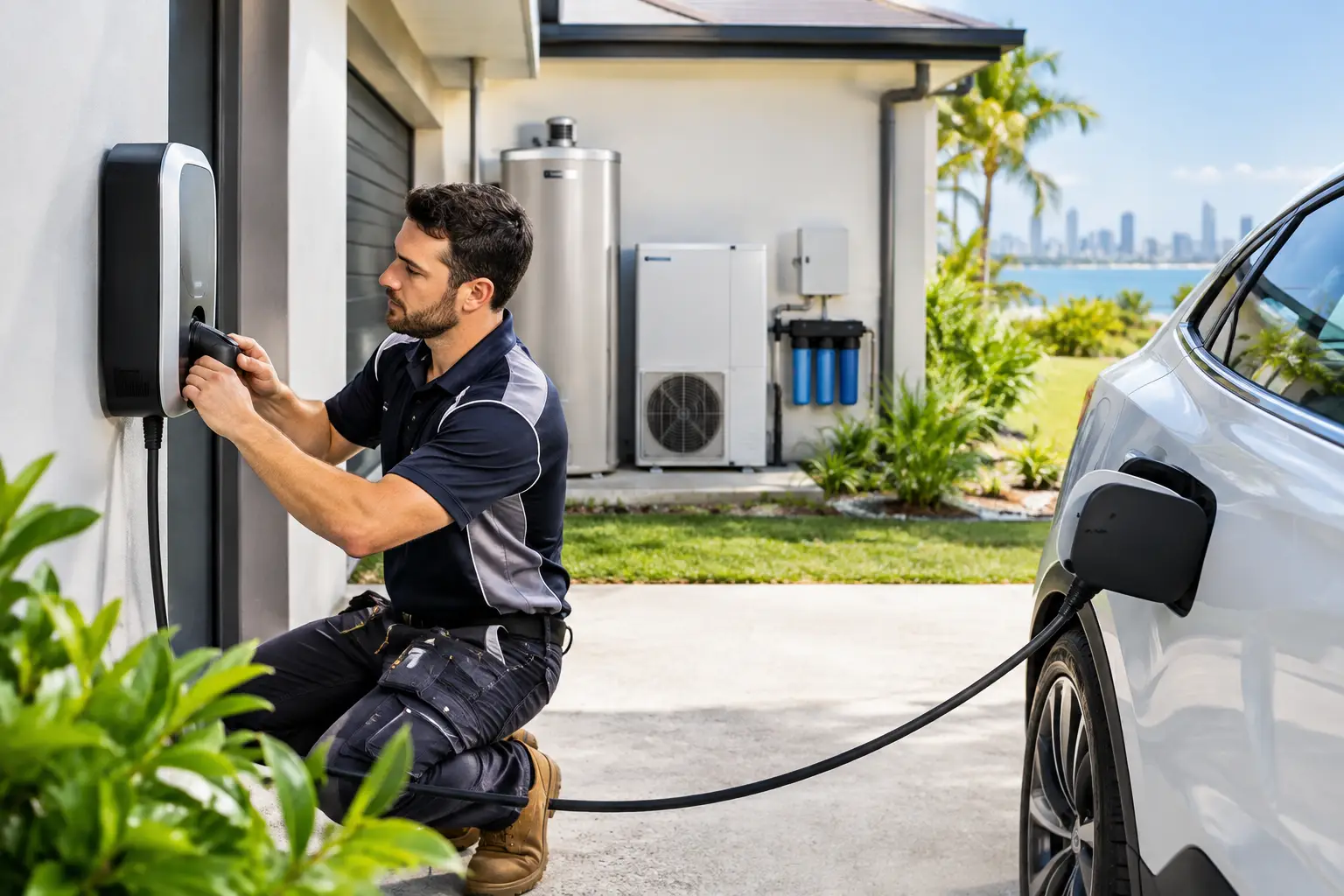
Pulling into the driveway and waking up to a fully charged car is the real benefit of home charging. But the best EV charger features are not always the ones with the longest spec sheet. For most households, the right charger is safe, easy to use, suits the way you drive, and is installed properly for your home’s electrical setup.
A good home EV charger should make daily charging simple without putting unnecessary pressure on your switchboard or your power bill. Here is what is worth looking for before you choose one.
Best EV Charger Features That Matter at Home
Charging speed that suits your power supply
For many Australian homes, a 7 kW charger is the practical sweet spot. It can add a useful amount of range overnight and usually works with a standard single-phase household supply, subject to your property’s electrical capacity and the vehicle’s onboard charging limit.
A 22 kW charger can sound like the obvious upgrade, but it needs three-phase power and an EV that can accept that charging speed. If your car only accepts 7 kW AC charging, fitting a 22 kW unit will not make it charge faster at home. It may still be worth considering if you expect to change vehicles, but only after checking what your home and vehicle can actually support.
The key is to match the charger to your real routine. A household that drives 40 to 80 kilometres most days has different needs from one with multiple EVs, long daily commutes, or frequent weekend trips.
Smart scheduling for lower-cost charging
Smart scheduling is one of the most useful features on a home charger. It lets you set charging times through an app or charger controls, so your vehicle charges when electricity is cheaper under your energy plan. You plug in when you arrive home, and the charger does the rest overnight.
This feature can also help households make better use of solar power. Some chargers can be set to favour surplus solar generation, meaning the car charges when your panels are producing more power than the house is using. The exact result depends on your solar system, electricity retailer plan, household usage and the charger’s capabilities.
Smart features are helpful when they save you time or money. They are less valuable if they rely on a complicated app you will never open after installation. Ask how the charger works if the internet drops out, whether essential charging controls remain available locally, and whether any functions require an ongoing subscription.
Dynamic load management to protect your home supply
An EV charger is one of the larger electrical loads in a typical home. On a hot Gold Coast afternoon, your air conditioning, pool equipment, oven and hot water system may already be working hard. Adding EV charging at full speed can push a property close to its available supply limit.
Dynamic load management monitors the household load and adjusts the charger’s output when needed. If the home is using plenty of power, the charger can temporarily reduce its charging rate. When demand drops, it can increase again.
For homes with smaller electrical supplies or plenty of high-demand appliances, this can be a far smarter solution than simply choosing a lower-powered charger. It helps avoid overloads while allowing you to charge efficiently when capacity is available. It is also especially useful where two EV chargers may eventually be needed.
Built-in safety protection and compliant installation
Safety is not an optional extra. Your charger should be suitable for Australian conditions and installed by a licensed electrician who checks the switchboard, circuit capacity, cable run, earthing and required protection devices.
Quality chargers include electrical safety features designed to detect faults and stop charging if something is not right. They should also be installed on a dedicated circuit with the appropriate protection for the specific unit and site. The right installation is not just about getting the charger mounted on the wall – it is about making sure the whole system works safely together.
Avoid treating a home EV charger like a plug-and-play appliance. Portable charging leads have their place, but a purpose-installed wall charger is generally the safer and more convenient option for regular daily use. It gives you a proper charging point, a tidy cable arrangement and confidence that the electrical work has been assessed properly.
Weather protection for where you park
Not every vehicle is parked in a closed garage. If your car lives under a carport, beside the house or in an exposed driveway, look for a charger with a suitable weather rating for its location. The cable, plug holder and mounting position matter as much as the charger itself.
A charger installed near the coast also needs careful placement and quality components that can handle local conditions. Your installer can help choose a position that is practical to reach, protected where possible, and less likely to create a trip hazard across the driveway or footpath.
Tethered cable or socketed design
This decision comes down to convenience versus flexibility. A tethered charger has a cable permanently attached. It is quick to use: park, plug in, and charge. For households with one EV and a consistent parking spot, that everyday ease is hard to beat.
A socketed charger has no fixed cable. You use the charging cable supplied with the vehicle or buy one separately. This can look neater and may suit homes where different vehicles use different connector types or cable lengths.
Think about where the charging port is on your vehicle. A cable that is too short can become frustrating very quickly, while an unnecessarily long cable can be bulky to handle. A properly planned charger location usually matters more than choosing the longest lead available.
App controls, notifications and access control
Useful app features include charge status, scheduled charging, energy-use tracking and notifications when charging starts, stops or is interrupted. These are practical when your charger is outside or you want to check charging from inside the house.
Access control may also matter. If the charger is near the street, shared between tenants, or installed at an investment property, RFID cards, PIN controls or app-based permissions can prevent unauthorised use. For a private garage, simpler may be better.
Energy monitoring can be handy, but treat it as a guide rather than a substitute for your electricity bill or a full home energy monitor. The figures shown depend on how the charger measures use and what is included in its reporting.
Choosing the Best EV Charger Features Without Overspending
It is easy to pay for functions you do not need. A basic, quality 7 kW charger with safe installation may be the best choice for one car, overnight charging and a straightforward household routine. Smart scheduling becomes more valuable if you have time-of-use electricity pricing. Load management can be worth every dollar if your home has air conditioning, electric hot water, a pool or limited electrical capacity.
Future-proofing is sensible, but it should be realistic. If you are planning solar, a battery, a second EV or a switchboard upgrade in the next few years, mention it before the quote is prepared. It may affect the charger model, cable sizing, protective equipment and installation approach.
The upfront price should also be clear. Charger supply is only one part of the job. The distance from the switchboard, wall construction, trenching, switchboard upgrades, cable route and electrical capacity can all affect the final installation cost. A fixed quote based on a proper assessment gives you a clearer picture than a headline price that excludes the hard parts.
A Better Way to Plan Your EV Charger Installation
Before booking, have a quick look at where the car normally parks, where your switchboard is located, and whether you have single-phase or three-phase power. It also helps to know your EV model, typical daily kilometres, solar plans and whether another EV may join the household later.
A licensed installer can then recommend a charger that fits the property instead of simply selling the biggest unit available. For homeowners across the Gold Coast and nearby areas, No Hassle Homes can supply and install EV chargers with the same straightforward approach used for other essential home services: clear advice, qualified work and no unnecessary run-around.
The best charger is the one you barely have to think about. Park at home, plug in, let it charge safely at the right time, and get on with your day.