


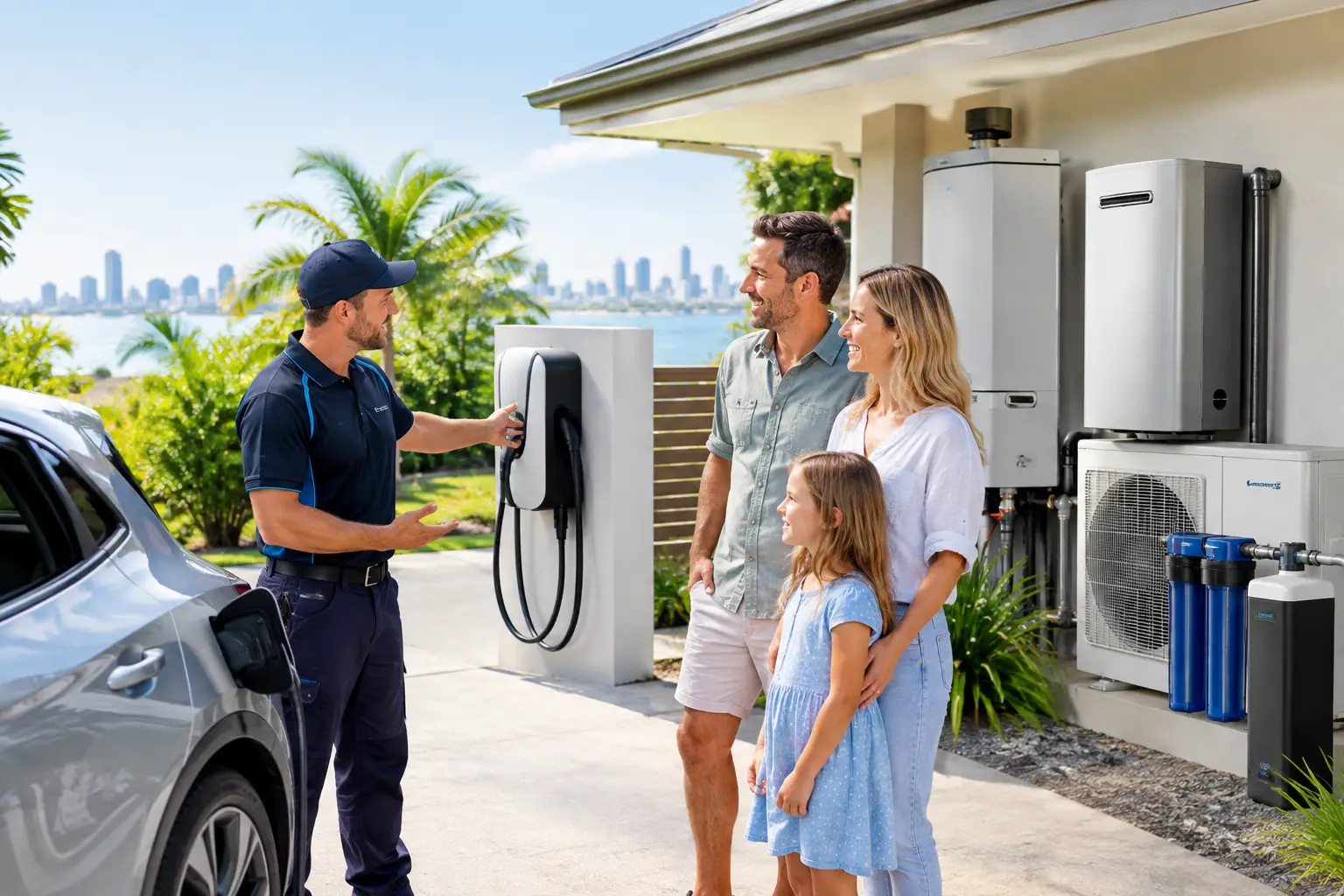
A public charger is handy when you are out, but home charging is what makes owning an EV easy. Plug in after work, wake up with useful range, and stop planning your week around a charging stop. The key is to select EV chargers that suit your vehicle, electrical supply and normal driving habits – not simply the biggest unit on the shelf.
For most households, the right charger is a safe, professionally installed wall unit that charges overnight without putting unnecessary strain on the home’s electrical system. The best choice depends on a few practical details, and sorting them before installation avoids costly changes later.
How to select EV chargers that suit your home
Start with the car you have now, then allow for the car you may own in a few years. Check the vehicle’s maximum AC charging rate, as this determines how much power it can accept at home. A charger with a higher rating will not make a vehicle charge faster than its onboard equipment allows.
Most homes across the Gold Coast and surrounding areas have single-phase power. In that case, a 7 kW charger is often the sensible option. It can add a substantial amount of range overnight and suits the charging needs of many families, commuters and retirees. It is also more realistic for typical household wiring than a high-powered unit.
Three-phase power can support faster charging, including 11 kW or 22 kW options, but faster is not automatically better. A 22 kW charger may require a larger electrical supply, more switchboard work and a vehicle capable of accepting that rate. If the car sits in the driveway or garage for 10 to 12 hours most nights, a 7 kW charger may do the job comfortably at a lower installation cost.
Think about your actual routine. A household travelling 30 to 60 kilometres most days has very different charging needs from a family regularly driving to Brisbane, down the coast or interstate. Your electrician can help match the charger’s output to the kilometres you need to replace between trips.
Choose a charger with the right connector
Most newer EVs sold in Australia use a Type 2 connection for AC charging. Some chargers have a fixed cable, while others have a socket that lets you use your own cable.
A tethered charger is convenient. The cable is always there, so you simply park, plug in and get on with your evening. A socketed unit can be neater where different cars may use the charger or where you prefer to store the cable away. Neither option is universally better. It comes down to how your household uses the driveway and whether you expect to change vehicles soon.
If you have a plug-in hybrid, check its maximum charging rate carefully. Many plug-in hybrids charge at a lower rate than full EVs, so an expensive high-output charger may provide no day-to-day benefit.
Check your switchboard before choosing charging speed
An EV charger is one of the larger electrical loads in a home. It needs its own dedicated circuit and the correct protection devices. Before deciding on a charger, a licensed electrician should inspect the switchboard, main supply, earthing and available capacity.
This is especially relevant in older homes, properties with electric hot water, ducted air conditioning, a pool, spa or induction cooktop. Each system may run at the same busy time of day. Adding an EV charger without assessing the full load can lead to nuisance tripping or the need for unexpected upgrade work.
Load management can be a smart answer. This feature monitors the home’s electricity use and automatically reduces the charger’s output when demand is high. When the air conditioning, oven or other big appliances switch off, the charger can increase again. It helps many homes install EV charging without upgrading to a larger supply straight away.
A good installer will explain what is included in the quote and flag any switchboard upgrades, cable runs or trenching that may be required. Clear pricing matters here. The cheapest advertised charger can become expensive if the installation conditions have not been properly considered.
Plan where the charger will go
The best location is normally close to where the car parks, with the cable reaching the charging port without stretching across a walkway. A garage wall is ideal for many homes, but carports and outdoor driveways can work well when the charger is rated and installed for the conditions.
Consider the daily details. Will a garage door, gate or parked second car get in the way? Can children or visitors trip over the cable? Is there a sensible route for cable from the switchboard to the charger? A longer run can increase installation cost, but placing the charger where it is genuinely easy to use is often worth it.
If the charger is outside, look for suitable weather protection and a location that avoids direct hose spray, pooling water and regular knocks from vehicles. A bollard or wheel stop may be worthwhile where parking is tight.
Smart features are useful, but keep them practical
Smart EV chargers can connect to an app, schedule charging, track electricity use and work with some solar systems. These features are useful when they solve a real household need rather than add another app to manage.
Scheduled charging is a good example. If your electricity plan offers cheaper off-peak periods, the charger can start automatically at those times. That can lower charging costs without changing your routine. Usage tracking may also help if you want to understand how much electricity the vehicle uses each month.
Solar-aware charging is worth considering if you already have solar panels or plan to install them. Depending on the charger and system setup, the unit can favour excess solar generation during the day. This can be a great fit for people who work from home or have a car parked at home through daylight hours. It is less useful if the vehicle is usually away during the day, unless you have battery storage or regularly charge on weekends.
Do not choose a charger on app features alone. Reliable hardware, correct electrical protection and a professional installation come first. A straightforward charger that works every night is better than a feature-packed unit that is poorly suited to the property.
Safety and installation are not the place to cut corners
EV charger installation involves high-current electrical work. It should be completed by a licensed electrician, with the work tested and certified in line with applicable Australian standards and local requirements. A standard power point may be suitable for occasional or temporary charging in some situations, but it is not the best long-term answer for regular EV charging.
A dedicated wall charger is designed for repeated use and provides faster, more controlled charging. It also keeps the setup tidier and reduces reliance on extension leads or improvised arrangements. Never run charging cables across a footpath, driveway or area where they can be damaged, tripped over or exposed to water.
Ask your installer what is included before booking. A clear scope should cover the charger supply if required, mounting, circuit protection, cabling allowances, testing and certification. If your home needs extra work, you should know why and what it will cost before the job starts.
Think ahead without overbuying
It makes sense to allow for future needs, particularly if your household may own two EVs. That does not always mean installing two chargers now. You may be able to choose a charger and cable route that make a second installation simpler later.
For two-car households, smart load sharing can be more cost-effective than upgrading the supply for two chargers running at full power. The chargers share available capacity, so both cars can charge safely overnight. Again, whether this is worthwhile depends on how far each vehicle travels and how often both need charging at once.
If you are building or renovating, this is the ideal time to plan. Installing suitable conduit and allowing room in the switchboard while walls or paths are open can save money later. Even if you do not buy an EV for several years, basic electrical preparation is a practical addition to a future-ready home.
The right charger should fit quietly into your household routine: park, plug in and let the car charge while life carries on. A proper site assessment and an honest fixed quote give you the confidence to choose once, install safely and enjoy the convenience every day.